
Giải SBT Tiếng Anh lớp 12 Unit 7: Media - Friends Global
Với giải sách bài tập Tiếng Anh lớp 12 Unit 7: Media sách Friends Global hay nhất, chi tiết sẽ giúp học sinh dễ dàng làm bài tập về nhà trong SBT Tiếng Anh lớp 12.
Giải SBT Tiếng Anh lớp 12 Unit 7: Media - Friends Global
Traditional and social media (Phương tiện truyền thông truyền thống và xã hội)
1 (trang 56 SBT Tiếng Anh 12 Friends Global): Complete the text with the correct form of the verbs below. (Hoàn thành đoạn văn với dạng đúng của động từ dưới đây.)
disguise exaggerate lie
influence pass photoshop
You can't say that adverts 1 _____ about products to consumers, but I think it's true to say they 2 _____ what products can do. Advertisers try to 3 _____ our emotions with images of attractive people and places. Furthermore, they have been known to 4 _____ images so that products look better than they really are. Often, food and drinks manufacturers 5 _____ off products which have too much sugar as 'energy food' and 6 _____ the fact that some products contain ingredients that are not good for us.
Đáp án:
|
1. lie |
2. exaggerate |
3. influence |
|
4. photoshop |
5. pass |
6. disguise |
Giải thích:
disguise (v): cải trang
exaggerate (v): phóng đại
lie (v): nói dối
influence (v): ảnh hưởng
pass (v): vượt qua
Hướng dẫn dịch:
You can't say that adverts lie about products to consumers, but I think it's true to say they exaggerate what products can do. Advertisers try to influence our emotions with images of attractive people and places. Furthermore, they have been known to photoshop images so that products look better than they really are. Often, food and drinks manufacturers pass off products which have too much sugar as 'energy food' and disguise the fact that some products contain ingredients that are not good for us.
(Cậu không thể nói rằng quảng cáo nói dối về sản phẩm đối với người tiêu dùng, nhưng tớ nghĩ đúng khi nói rằng họ phóng đại những gì sản phẩm có thể làm được. Các nhà quảng cáo cố gắng tác động đến cảm xúc của chúng ta bằng hình ảnh những con người và địa điểm hấp dẫn. Hơn nữa, họ còn biết đến việc photoshop hình ảnh để sản phẩm trông đẹp hơn thực tế. Thông thường, các nhà sản xuất thực phẩm và đồ uống quảng cáo những sản phẩm có quá nhiều đường là 'thực phẩm năng lượng' và ngụy trang sự thật rằng một số sản phẩm có chứa những thành phần không tốt cho chúng ta.)
2 (trang 56 SBT Tiếng Anh 12 Friends Global): Complete the sentences with the correct form of the verbs. (Hoàn thành câu với dạng đúng của động từ.)
cheat lie disseminate mislead swear
1. Sam was told to leave the exam because he was using his mobile phone and _______.
2. The children were ______ when they said that the dog ate the cake.
3. You have to ______ to tell the truth in a court of law.
4. The business tried to ______ positive news about their products.
5. Jack ______ his parents about what he had really been doing on Friday evening.
Đáp án:
|
1. cheating |
2. lying |
3. swear |
4. disseminate |
5. misled |
Giải thích:
cheat (v): gian lận
lie (v): nói dối
disseminate (v): phổ biến
mislead (v): đánh lạc hướng
swear (v): thể
Hướng dẫn dịch:
1. Sam was told to leave the exam because he was using his mobile phone and cheating.
(Sam bị yêu cầu bỏ kỳ thi vì sử dụng điện thoại di động và gian lận.)
2. The children were lying when they said that the dog ate the cake.
(Bọn trẻ đã nói dối khi nói rằng con chó đã ăn chiếc bánh.)
3. You have to swear to tell the truth in a court of law.
(Cậu phải thề nói sự thật trước tòa án.)
4. The business tried to disseminate positive news about their products.
(Doanh nghiệp đã cố gắng phổ biến những tin tức tích cực về sản phẩm của họ.)
5. Jack misled his parents about what he had really been doing on Friday evening.
(Jack đã lừa dối bố mẹ về những gì anh ấy thực sự đã làm vào tối thứ Sáu.)
3 (trang 56 SBT Tiếng Anh 12 Friends Global): Listen to the dialogues and choose the correct answers (a-c). (Nghe đoạn hội thoại và chọn câu trả lời đúng (a-c).)
Bài nghe:
Dialogue 1
1. What is Jessica doing at the beginning of the dialogue?
a Making an excuse
b Telling the truth
c Cheating
2. What does Tom want Jessica to do?
a Deceive somebody
b Lie about something to somebody
c Own up to something
3. What does Jessica find difficult to do?
a Tell a lie
b Tell the truth
c Fool Tom
Dialogue 2
4. What is Grace doing?
a Photoshopping a picture
b Disguising her friend
c Telling the truth
5. What does Grace say she hasn't done?
a Improved the story
b Made the story more amusing
c Fabricated a story
6. What does Leo think a newspaper should do?
a Portray things as more interesting than they are
b Tell the truth
c Reveal secrets
Đáp án:
|
1. a |
2. c |
3. b |
4. a |
5. c |
6. b |
Nội dung bài nghe:
Dialogue 1
Jessica: Look, Tom, I’m afraid that I’m not going to be able to come to the cinema tonight after all.
Tom: Oh dear. Why not?
Jessica: I’ve got to do something at home.
Tom: Are you sure, Jessica? This is the second time that you’ve cancelled a date. If you don’t want to go out with me, just tell me. I’ll survive!
Jessica: But Tom, I do want to go out with you. It’s just that …
Tom: Just tell me the truth, Jessica!
Jessica: I will, it’s just difficult … You see, it’s my parents … They don’t want me to go out with you.
Dialogue 2
Leo: Are you working on the school newspaper, Grace?
Grace: Yes, I’m just adding a photo to my article about our school trip.
Leo: But who’s that?
Grace: It’s Molly.
Leo: Molly? But that doesn’t look anything like her!
Grace: Well, I’ve just improved the photo a little.
Leo: A little?! Even her parents wouldn’t recognise her! You can’t do that! What about the article? Have you been honest about what happened?
Grace: Well, I’ve made it a little bit more interesting, otherwise it would be boring.
Leo: You mean you’ve invented things.
Grace: Invented things? I’d never do that, Leo! I’ve just made things seem a little funnier than they really were.
Leo: But the idea of a newspaper is to explain what really happened.
Grace: Oh come on, I’m not lying to anyone. I’m just making it a little more entertaining!
Hướng dẫn dịch:
Hội thoại 1
Jessica: Nghe này Tom, tớ e rằng tối nay tôi sẽ không thể đến rạp chiếu phim được.
Tom: Ôi trời. Tại sao không?
Jessica: Tớ phải làm việc gì đó ở nhà.
Tom: Cậu có chắc không, Jessica? Đây là lần thứ hai cậu hủy một cuộc hẹn. Nếu cậu không muốn đi chơi với tớ, hãy nói với tớ. Tớ ổn!
Jessica: Nhưng Tom, tớ muốn đi chơi với cậu. Chỉ là…
Tom: Hãy nói cho tớ sự thật đi, Jessica!
Jessica: Tớ sẽ làm vậy, chỉ là khó khăn thôi… Cậu thấy đấy, đó là bố mẹ tớ… Họ không muốn tớ đi chơi với cậu.
Hội thoại 2
Leo: Cậu đang làm việc cho tờ báo của trường phải không, Grace?
Grace: Vâng, tớ chỉ thêm một bức ảnh vào bài viết về chuyến đi học của chúng tớ.
Leo: Nhưng đó là ai?
Grace: Đó là Molly.
Leo: Molly? Nhưng nó trông không giống cô ấy chút nào!
Grace: À, tớ chỉ cải thiện bức ảnh một chút thôi.
Leo: Một chút?! Ngay cả bố mẹ cô cũng không nhận ra cô! Cậu không thể làm điều đó! Còn bài báo thì sao? Cậu đã thành thật về những gì đã xảy ra chưa?
Grace: À, tớ đã làm cho nó thú vị hơn một chút, nếu không thì sẽ nhàm chán.
Leo: Ý cậu là cậu đã bịa ra nhiều thứ.
Grace: Những thứ được bịa ra? Tớ sẽ không bao giờ làm điều đó, Leo! Tớ vừa làm mọi thứ có vẻ buồn cười hơn thực tế một chút.
Leo: Nhưng ý tưởng của một tờ báo là giải thích những gì thực sự đã xảy ra.
Grace: Thôi nào, tớ không nói dối ai cả. Tớ chỉ làm nó thú vị hơn một chút thôi!
4 (trang 56 SBT Tiếng Anh 12 Friends Global): Complete the sentences with the correct verbs. (Hoàn thành câu với các động từ đúng.)
1. A lot of people won't tell you anything face to face, but then r_____ all their secrets on the internet.
2. Nicola l_____ to me about the date of her party!
3. He always m_____ excuses for his mistakes and never accepts responsibility for anything!
4. Alex keeps telling us that he is the best singer in class, and we all know he is f_____ himself
5. The machine d_____ his voice so you didn't know who was speaking.
Đáp án:
|
1. reveal |
2. lied |
3. makes up |
4. flattering |
5. disguised |
Hướng dẫn dịch:
1. A lot of people won't tell you anything face to face, but then reveal all their secrets on the internet.
(Rất nhiều người sẽ không nói trực tiếp với cậu bất cứ điều gì mà sau đó tiết lộ tất cả bí mật của họ trên internet.)
2. Nicola lied to me about the date of her party!
(Nicola đã nói dối tớ về ngày tổ chức bữa tiệc của cô ấy!)
3. He always makes up excuses for his mistakes and never accepts responsibility for anything!
(Anh ấy luôn bào chữa cho những sai lầm của mình và không bao giờ chịu trách nhiệm về bất cứ điều gì!)
4. Alex keeps telling us that he is the best singer in class, and we all know he is flattering himself
(Alex liên tục nói với chúng tớ rằng anh ấy là ca sĩ giỏi nhất lớp và tất cả chúng tớ đều biết anh ấy đang tự tâng bốc mình)
5. The machine disguised his voice so you didn't know who was speaking.
(Máy đã ngụy trang giọng nói của anh ấy để cậu không biết ai đang nói.)
5 (trang 56 SBT Tiếng Anh 12 Friends Global): Choose the correct words to complete the sentences. (Chọn từ đúng để hoàn thành câu.)
1. It's so dishonest / daunting to tell people to help when you don't do anything yourself!
2. The lecture of Professor Jenkins was very biased / informative and it seemed as if we had read a few books.
3. I like Sara's direct / neutral manner, even if she sometimes criticises what I have done.
4. Carlos has had a good decision of his career thanks to the teacher's genuine / encouraging remark.
5. I wanted to give Frank a(n) provocative / honest answer, but I couldn't tell him his suit looked awful, could I?
Đáp án:
|
1. dishonest |
2. informative |
3. direct |
4. encouraging |
5. honest |
Giải thích:
dishonest (adj): không trung thực
daunting (adj): làm nản lòng
biased (adj): thiên vị
informative (adj): nhiều thông tin
direct (adj): trực tiếp
neutral (adj): trung lập
genuine (adj): thành thật
encouraging (adj): đáng khích lệ
provocative (adj): trêu chọc
honest (adj): trung thực
Hướng dẫn dịch:
1. It's so dishonest to tell people to help when you don't do anything yourself!
(Thật là không trung thực khi bảo người khác giúp đỡ trong khi bản thân cậu không làm gì cả!)
2. The lecture of Professor Jenkins was very informative and it seemed as if we had read a few books.
(Bài giảng của Giáo sư Jenkins rất giàu thông tin và dường như chúng tớ đã đọc được vài cuốn sách.)
3. I like Sara's direct manner, even if she sometimes criticises what I have done.
(Tớ thích cách cư xử thẳng thắn của Sara, ngay cả khi cô ấy đôi khi chỉ trích những gì tớ đã làm.)
4. Carlos has had a good decision of his career thanks to the teacher's encouraging remark.
(Carlos đã có quyết định đúng đắn trong sự nghiệp nhờ lời động viên của thầy.)
5. I wanted to give Frank a honest answer, but I couldn't tell him his suit looked awful, could I?
(Tớ muốn cho Frank một câu trả lời trung thực, nhưng tớ không thể nói với anh ấy rằng bộ đồ của anh ấy trông tệ quá phải không?)
6 (trang 56 SBT Tiếng Anh 12 Friends Global): Match the adjectives below with the descriptions. (Hãy nối những tính từ dưới đây với những lời mô tả.)
neutral fake straight trustworthy truthful
1. Someone who is honest and says what they think. _______
2. Someone who does not support or help either side in a disagreement. _______
3. Something which is not genuine. _______
4. Someone who can be relied upon to do the right thing and to be honest. _______
5. Someone who says only what is true. _______
Đáp án:
|
1. straight |
2. neutral |
3. fake |
4. trustworthy |
5. truthful |
Giải thích:
neutral (adj): trung lập
fake (adj): giả mạo
straight (adj): thẳng thắn
trustworthy (adj): đáng tin cậy
truthful (adj): trung thực
Hướng dẫn dịch:
1. Someone who is honest and says what they think - straight
(Một người trung thực và nói những gì họ nghĩ - thẳng thắn)
2. Someone who does not support or help either side in a disagreement - neutral
(Người không ủng hộ hoặc giúp đỡ một trong hai bên khi có bất đồng - trung lập)
3. Something which is not genuine - fake
(Một cái gì đó không có thật - giả mạo)
4. Someone who can be relied upon to do the right thing and to be honest - trustworthy
(Người có thể tin cậy để làm điều đúng đắn và trung thực - đáng tin cậy)
5. Someone who says only what is true - truthful
(Người chỉ nói những gì đúng sự thật - trung thực)
Reported speech (Câu trần thuật)
1 (trang 57 SBT Tiếng Anh 12 Friends Global): Change the direct speech into reported speech. (Chuyển lời nói trực tiếp sang câu tường thuật.)
1. 'You must take these tablets twice a day!'
The doctor says I ____________________
2. 'I'm going to the gym tomorrow'
Ben told me ____________________
3. 'You don't have to wait for me.'
Liz said that I ____________________
4. 'I took my final exam yesterday!'
Jack told me ____________________
5. 'I haven't told you the complete truth.'
Pablo said ____________________
6. 'I'll meet you later today!'
Jim tells me ____________________
7. 'I prefer this café to the one opposite.'
Julia says ____________________
8. 'I'll always remember meeting you!'
Ann told me ____________________
Đáp án:
1. The doctor says I must take these tablets twice a day.
2. Ben told me he was going to the gym the next day.
3. Liz said that I didn’t have to wait for her.
4. Jack told me he had taken his final exam the day before.
5. Pablo said he hadn’t told me the complete truth.
6. Jim tells me he’ll meet me later today.
7. Julia says she prefers this café to the one opposite.
8. Ann told me she would always remember meeting me.
Giải thích:
Cấu trúc câu tường thuật dạng câu kể:
- S + động từ tường thuật (V2/ed) + S + V (lùi thì).
- S + động từ tường thuật (V1) + S + V (chia thì).
Hướng dẫn dịch:
1. The doctor says I must take these tablets twice a day.
(Bác sĩ nói tớ phải uống những viên thuốc này hai lần một ngày.)
2. Ben told me he was going to the gym the next day.
(Ben nói với tớ rằng anh ấy sẽ đến phòng tập thể hình vào ngày hôm sau.)
3. Liz said that I didn’t have to wait for her.
(Liz nói rằng tớ không cần phải đợi cô ấy.)
4. Jack told me he had taken his final exam the day before.
(Jack kể với tớ rằng anh ấy đã làm bài kiểm tra cuối kỳ vào ngày hôm trước.)
5. Pablo said he hadn’t told me the complete truth.
(Pablo nói anh ấy chưa kể cho tớ toàn bộ sự thật.)
6. Jim tells me he’ll meet me later today.
(Jim nói với tớ rằng anh ấy sẽ gặp tớ sau hôm nay.)
7. Julia says she prefers this café to the one opposite.
(Julia nói rằng cô ấy thích quán cà phê này hơn quán cà phê đối diện.)
8. Ann told me she would always remember meeting me.
(Ann nói với tớ rằng cô ấy sẽ luôn nhớ đã gặp tớ.)
2 (trang 57 SBT Tiếng Anh 12 Friends Global): Complete the sentences with the correct form of the words in brackets. Do not change the order of the words. Use a maximum of five words including the words in brackets. (Hoàn thành câu với dạng đúng của từ trong ngoặc. Đừng thay đổi thứ tự của các từ. Sử dụng tối đa 5 từ bao gồm cả những từ trong ngoặc.)
1. Will asked us ____________ (time / game / start) the next day.
2. The assistant asked him if ____________ (he / like / try) on a smaller jacket.
3. My teacher asked me ____________ (I / finish) the exercise and I said I hadn't.
4. I asked Maria ____________ (which / film / seen) the night before.
5. The dentist asked ____________ (me / why) never used an electric toothbrush before.
6. She asked him if ____________ (he / going) the park and he said he wasn't.
7. I asked the policeman whether ____________ (he / help / us) and he said he could.
Đáp án:
1. Will asked us what time the game started the next day.
2. The assistant asked him if he would like to try on a smaller jacket.
3. My teacher asked me if I had finished the exercise and I said I hadn't.
4. I asked Maria which film she had seen the night before.
5. The dentist asked me why I had never used an electric toothbrush before.
6. She asked him if he was going to the park and he said he wasn't.
7. I asked the policeman whether he could help us and he said he could.
Giải thích:
Cấu trúc câu tường thuật dạng câu hỏi Wh-: S + asked + O + wh- + S + V (lùi thì).
Cấu trúc câu tường thuật dạng câu hỏi Yes/No: S + asked + O + If / whether + S + V (lùi thì).
Hướng dẫn dịch:
1. Will asked us what time the game started the next day.
(Will hỏi chúng tớ trận đấu bắt đầu vào ngày hôm sau lúc mấy giờ.)
2. The assistant asked him if he would like to try on a smaller jacket.
(Người trợ lý hỏi anh ấy có muốn thử chiếc áo khoác nhỏ hơn không.)
3. My teacher asked me if I had finished the exercise and I said I hadn't.
(Giáo viên hỏi tớ đã làm xong bài tập chưa và tớ nói chưa.)
4. I asked Maria which film she had seen the night before.
(Tớ hỏi Maria cô ấy đã xem bộ phim nào tối hôm trước.)
5. The dentist asked me why I had never used an electric toothbrush before.
(Nha sĩ hỏi tớ tại sao trước đây tớ chưa bao giờ sử dụng bàn chải đánh răng điện.)
6. She asked him if he was going to the park and he said he wasn't.
(Cô ấy hỏi anh ấy có đi công viên không và anh ấy nói không.)
7. I asked the policeman whether he could help us and he said he could.
(Tớ hỏi viên cảnh sát liệu anh ta có thể giúp chúng tớ không và anh ta nói có thể.)
3 (trang 57 SBT Tiếng Anh 12 Friends Global): Change the direct speech into reported speech. Begin with My mum asked me. (Chuyển lời nói trực tiếp sang câu tường thuật. Bắt đầu với Mẹ tôi hỏi tôi.)
1. 'Why are you home so late?'
________________________________
2. 'Did you leave school on time today?'
________________________________
3. 'When are you going to tidy your room?'
________________________________
4. 'Have you seen your brother this afternoon?'
________________________________
5. 'Will you help me with the shopping tomorrow?'
________________________________
6. 'Would you like me to give you some money for a pizza?'
________________________________
Đáp án:
1. My mum asked me why I was home so late.
2. My mum asked me if I had left school on time that day.
3. My mum asked me when I was going to tidy my room.
4. My mum asked me if I had seen my brother that afternoon.
5. My mum asked me if I’d help her with the shopping the next day.
6. My mum asked me if I’d like her to give me some money for a pizza.
Giải thích:
Cấu trúc câu tường thuật dạng câu hỏi Wh-: S + asked + O + wh- + S + V (lùi thì).
Cấu trúc câu tường thuật dạng câu hỏi Yes/No: S + asked + O + If / whether + S + V (lùi thì).
Hướng dẫn dịch:
1. My mum asked me why I was home so late.
(Mẹ tớ hỏi tại sao tớ về nhà muộn thế.)
2. My mum asked me if I had left school on time that day.
(Mẹ tớ hỏi hôm đó tớ có tan học đúng giờ không.)
3. My mum asked me when I was going to tidy my room.
(Mẹ hỏi tớ khi nào tớ sẽ dọn phòng.)
4. My mum asked me if I had seen my brother that afternoon.
(Mẹ tớ hỏi tớ có gặp anh trai tớ chiều hôm đó không.)
5. My mum asked me if I’d help her with the shopping the next day.
(Mẹ hỏi tớ có giúp mẹ đi mua sắm vào ngày hôm sau không.)
6. My mum asked me if I’d like her to give me some money for a pizza.
(Mẹ tớ hỏi tớ có muốn mẹ cho tớ một ít tiền để mua một chiếc bánh pizza không.)
4 (trang 57 SBT Tiếng Anh 12 Friends Global): Report the dialogue using say or ask in the past simple. (Tường thuật đoạn hội thoại sử dụng say hoặc ask ở thì quá khứ đơn.)
Dan: Are you going to the concert tomorrow evening?
Zoe: No, I'm not. I haven't got any money.
Dan: I'll lend you some. How much do you need?
Zoe: That's really kind of you, but I have to finish my homework too.
Dan: Would you like me to help you finish it?
Zoe: Do you speak German?
Dan: No, I don't. Your cousin does, doesn't she?
Zoe: Yes, she does. Perhaps I should ask her.
_______________________________________________________
_______________________________________________________
Đáp án:
Dan asked Zoe if she was going to the concert the next evening. Zoe said she wasn’t. She said she didn’t have any money. Dan said he’d lend her some. He asked her how much she needed. Zoe said that was really kind of him, but she had to finish her homework too. Dan asked her if she’d like him to help her finish it. Zoe asked him if he spoke German. Dan said he didn’t. He asked her if her cousin did. Zoe said she did. She said perhaps she should ask her.
Giải thích:
Cấu trúc câu tường thuật dạng câu kể:
- S + động từ tường thuật (V2/ed) + S + V (lùi thì).
Cấu trúc câu tường thuật dạng câu hỏi Wh-: S + asked + O + wh- + S + V (lùi thì).
Cấu trúc câu tường thuật dạng câu hỏi Yes/No: S + asked + O + If / whether + S + V (lùi thì).
Hướng dẫn dịch:
Dan asked Zoe if she was going to the concert the next evening. Zoe said she wasn’t. She said she didn’t have any money. Dan said he’d lend her some. He asked her how much she needed. Zoe said that was really kind of him, but she had to finish her homework too. Dan asked her if she’d like him to help her finish it. Zoe asked him if he spoke German. Dan said he didn’t. He asked her if her cousin did. Zoe said she did. She said perhaps she should ask her.
(Dan hỏi Zoe liệu cô ấy có đi xem buổi hòa nhạc vào tối hôm sau không. Zoe nói không. Cô ấy nói cô ấy không có tiền. Dan nói anh ấy sẽ cho cô ấy mượn một ít. Anh hỏi cô cần bao nhiêu. Zoe nói rằng anh ấy thật sự rất tốt bụng, nhưng cô ấy cũng phải hoàn thành bài tập về nhà. Dan hỏi liệu cô có muốn anh giúp cô hoàn thành nó không. Zoe hỏi anh ấy có nói được tiếng Đức không. Dan nói rằng anh ấy không. Anh ấy hỏi cô ấy liệu chị họ của cô ấy có không. Zoe nói cô ấy có. Cô ấy nói có lẽ nên hỏi cô ấy.)
5 (trang 57 SBT Tiếng Anh 12 Friends Global): Write a second sentence that has a similar meaning to the first. Use the words in brackets. (Viết câu thứ hai có nghĩa tương tự như câu đầu tiên. Sử dụng các từ trong ngoặc.)
1. ‘Do you know the answer to these questions?’ Sally asked me. (if)
2. 'I mustn't be late for the trip tomorrow,' said Bella. (next)
3. 'Have you heard the band's new album yet?' asked Kostas. (me)
4. 'I won't be at school next week,' said Mark. (says)
5. 'My plane arrives at ten in the morning,' said Andrew. (tells)
Đáp án:
1. Sally asked me if I knew the answer to the / those questions
2. Bella said that she mustn’t be late for the trip the next day
3. Kostas asked me if I’d heard the band’s new album yet.
4. Mark says that he won’t be at school next week.
5. Andrew tells me that his plane arrives at ten in the morning.
Giải thích:
Cấu trúc câu tường thuật dạng câu kể:
- S + động từ tường thuật (V2/ed) + S + V (lùi thì).
- S + động từ tường thuật (V1) + S + V (chia thì).
Cấu trúc câu tường thuật dạng câu hỏi Wh-: S + asked + O + wh- + S + V (lùi thì).
Cấu trúc câu tường thuật dạng câu hỏi Yes/No: S + asked + O + If / whether + S + V (lùi thì).
Hướng dẫn dịch:
1. Sally asked me if I knew the answer to the / those questions
(Sally hỏi tớ có biết câu trả lời cho những câu hỏi đó không)
2. Bella said that she mustn’t be late for the trip the next day
(Bella nói rằng cô ấy không được trễ chuyến đi vào ngày hôm sau)
3. Kostas asked me if I’d heard the band’s new album yet.
(Kostas hỏi tớ đã nghe album mới của ban nhạc chưa.)
4. Mark says that he won’t be at school next week.
(Mark nói rằng tuần tới anh ấy sẽ không đến trường.)
5. Andrew tells me that his plane arrives at ten in the morning.
(Andrew nói với tớ rằng máy bay của anh ấy đến lúc 10 giờ sáng.)
Urban legends (Truyền thuyết đô thị)
1 (trang 58 SBT Tiếng Anh 12 Friends Global): Read the Listening Strategy. Then listen to the sentences and choose the tone of voice (a or b) each speaker uses. (Đọc Chiến lược nghe. Sau đó nghe các câu và chọn tông giọng (a hoặc b) mà mỗi người nói sẽ sử dụng.)
Bài nghe:
1. Is that letter for me?
a nervous
b surprised
2. No, that's not right. Let me show you.
a angry
b patient
3. This is my seat.
a certain
b uncertain
4. That makes me feel much better.
a sarcastic
b enthusiastic
5. That didn't hurt at all.
a surprised
b sarcastic
6. The film's quite good.
a unsure
b enthusiastic
7. He's never on time.
a irritated
b patient
8. This party's brilliant.
a sarcastic
b enthusiastic
Đáp án:
|
1. a |
2. b |
3. b |
4. a |
5. a |
6. a |
7. a |
8. b |
Nội dung bài nghe:
1. Is that letter for me?
2. No, that’s not right. Let me show you.
3. This is my seat.
4. That makes me feel much better.
5. That didn’t hurt at all.
6. The film’s quite good.
7. He’s never on time.
8. This party’s brilliant.
Hướng dẫn dịch:
1. Bức thư đó có phải dành cho tớ không?
2. Không, điều đó không đúng. Tớ sẽ cho bạn xem.
3. Đây là chỗ ngồi của tớ.
4. Điều đó làm tớ cảm thấy tốt hơn nhiều.
5. Điều đó không hề đau chút nào.
6. Phim khá hay.
7. Anh ấy không bao giờ đúng giờ.
8. Bữa tiệc này thật tuyệt vời.
2 (trang 58 SBT Tiếng Anh 12 Friends Global): Listen again and repeat the sentences, copying the tone of voice. (Nghe lại và lặp lại các câu, bắt chước giọng điệu.)
(Học sinh tự thực hành)
3 (trang 58 SBT Tiếng Anh 12 Friends Global): Now try saying the sentences in exercise 1 in the other tone of voice. (Bây giờ hãy thử nói các câu trong bài tập 1 bằng giọng điệu khác.)
(Học sinh tự thực hành)
4 (trang 58 SBT Tiếng Anh 12 Friends Global): Listen and repeat the different intonation patterns for statements. (Nghe và lặp lại các mẫu ngữ điệu khác nhau cho các câu phát biểu.)
Bài nghe:
1. Certain
It's a great story.⇘
2. Uncertain
It's a great story.⇗
3. Qualifying
It's a great ⇗ story⇘.
4. Sarcastic
It's a great story. ⇒
Hướng dẫn dịch:
Certain = chắc chắn
Uncertain = không chắc chắn
Qualifying = đủ điều kiện
Sarcastic = mỉa mai
5 (trang 58 SBT Tiếng Anh 12 Friends Global): Listen to these statements being said in two different ways. Number them 1 and 2 in the order you hear them. Practise saying them. (Hãy lắng nghe những phát biểu này được nói theo hai cách khác nhau. Đánh số 1 và 2 theo thứ tự bạn nghe được. Hãy tập nói chúng.)
Bài nghe:
1. You like this kind of story.
a certain
b uncertain
2. This is just what I wanted.
a certain
b sarcastic
3. This isn't quite what I was expecting
a qualifying
b certain
4. He thinks it's a reasonable price.
a qualifying
b uncertain
5. This steak is the best I've ever eaten.
a sarcastic
b certain
6. That's really nice of him.
a uncertain
b sarcastic
Đáp án:
|
1. a, b |
2. b, a |
3. a, b |
4. b, a |
5. b, a |
6. a, b |
Hướng dẫn dịch:
1. You like this kind of story.
(Cậu thích thể loại truyện này.)
2. This is just what I wanted.
(Đây chính là điều tớ mong muốn.)
3. This isn't quite what I was expecting
(Đây không hẳn là điều tớ mong đợi)
4. He thinks it's a reasonable price.
(Anh ấy nghĩ đó là một mức giá hợp lý.)
5. This steak is the best I've ever eaten.
(Món bít tết này là món ngon nhất tớ từng ăn.)
6. That's really nice of him.
(Anh ấy thật sự rất tử tế.)
6 (trang 58 SBT Tiếng Anh 12 Friends Global): Listen to the conversation. Choose the correct answers (a-d). (Nghe đoạn hội thoại. Chọn câu trả lời đúng (a-d).)
Bài nghe:
1. How does Max feel when he starts telling his story?
a Reluctant to tell it.
b Impatient with interruptions.
c Unsure how the story goes.
d Worried that it is too scary.
2. What is the story about?
a A ghost.
b A student who is lost.
c What to do in bad weather.
d The inhabitants of a village in Ireland.
3. What do the people listening think of the story?
a It's gripping.
b It's hilarious throughout.
c It's annoying.
d it's too similar to the first one.
4. What does Caro think of Max's comment about her?
a She's really annoyed.
b She admits that Max's comment could be right.
c She criticises Max in self-defence.
d She does not trust his opinion of her.
5. What does Max agree with Jill about?
a That Caro is easily fooled.
b That Caro is more good-natured than he is.
c That lan's story is better than his.
d That Ian should buy the coffees.
Đáp án:
|
1. b |
2. d |
3. a |
4. b |
5. b |
Nội dung bài nghe:
Max: Right, you lot. I have a horror story of my own for you. It won’t be as good as Ian’s, of course.
Ian: Of course it won’t, Max! But anyway, let’s hear it.
Jill: Fantastic! Is it as scary as the first one?
Caro: Hope not …
Ian: Don’t worry, Caro.
Max: Are you going to listen or what?
Ian: We’re all ears …
Caro: I hope it isn’t true …
Max: Shhh, Caro. Well, this story takes place on a cold, stormy night deep in the Irish countryside. John, a student, was by the side of the road, hitch-hiking. The storm was so strong that he could hardly see anything at all. He was desperate. Suddenly, he saw a car coming towards him very slowly …
Ian: Oh, it’s a bit like my story …
Caro: Oh, dear. I don’t like this story, either.
Max: Shh, Caro! It’s nothing like your story, Ian! Can I continue?
Jill: Please do. I’m listening, at least …
Max: Anyway, John was desperate for shelter so, without thinking about it, he jumped into the car … only to realise that there was nobody behind the wheel … ! Then the car started moving slowly off! The rain was lashing down and the storm was howling. John tried the door handle, but it wouldn’t open! He began to panic …
Jill: Good grief …
Max: The car started to pick up a little speed. Frightened, John peered out of the window and could just make out a bend in the road. He was terrified and thought he was going to die.
Caro: Oh no!
Max: Shh … Then, just before the car hit the trees on the curve, a ghostly hand appeared through the window and turned the wheel. John was frozen with fear.
Ian: Is it a ghost story … ?
Max: The car was gathering speed now down the hill through the furious storm. John clung on in terror … Finally, he could make out a light in the distance. People! Gathering all his strength he pushed the car door open, fell out into the night, and ran for his life towards the lights of the pub on the roadside.
Caro: Phew … Thank goodness for that …
Max: Shhh … Soaking wet and exhausted, John staggered into the pub, dazed and shaking, and started telling the few people there about the terrible experience he’d just had.
Jill: I bet.
Max: Suddenly, the pub doors burst open again …
Caro: Oh no …
Max: Two men came into the room … like John, they were wet to the skin and out of breath … They looked around the room, and spotted John crying in the corner. One man said to the other …
All: What?
Max: He said, ‘Look, there’s that idiot that got into the car while we were pushing it!’
Ian: Brilliant, Max! That’s hilarious. You had us on the edge of our seats, thinking something horrible was going to happen.
Jill: Yes, very clever!
Caro: Now, I do like that story! What a relief!
Max: Always happy to entertain … Well, there are plenty of funny urban legends as well as the horror ones.
Ian: True. And it was better than my story!
Max: Nah, mate. Anyway, Caro, you make a good listener. You believe anything anybody tells you!
Caro: That’s not fair! Well, actually, you may have a point there, Max. I can’t help it if I’m naturally trusting, can I?
Jill: It just means you’re a very nice person, Caro. Much nicer than Max.
Max: Hey! But Jill’s right. You are nicer than me, Caro. Come on, you lot. I’ll buy you all a coffee.
Ian: Well, that’s unexpectedly nice of you, Max! Let’s go, guys, before he changes his mind!
Hướng dẫn dịch:
Max: Đúng vậy, rất nhiều bạn. Tớ có một câu chuyện kinh dị của riêng tôi dành cho cậu. Tất nhiên là nó sẽ không tốt bằng của Ian.
Ian: Tất nhiên là không rồi, Max! Nhưng dù sao đi nữa, hãy nghe nó.
Jill: Tuyệt vời! Có đáng sợ như cái đầu không?
Caro: Mong là không…
Ian: Đừng lo lắng, Caro.
Max: Cậu có định lắng nghe hay không?
Ian: Tất cả chúng tớ đều tập trung nghe…
Caro: Tớ hy vọng đó không phải là sự thật…
Max: Suỵt, Caro. Chà, câu chuyện này diễn ra vào một đêm giông bão lạnh lẽo ở vùng nông thôn Ireland. John, một sinh viên, đang đi nhờ xe bên đường. Cơn bão mạnh đến nỗi anh hầu như không thể nhìn thấy gì cả. Anh ấy đã tuyệt vọng. Đột nhiên, anh nhìn thấy một chiếc ô tô đang lao về phía mình rất chậm…
Ian: Ồ, nó hơi giống câu chuyện của tớ…
Caro: Ôi trời. Tớ cũng không thích câu chuyện này.
Max: Suỵt, Caro! Nó không giống câu chuyện của cậu, Ian! Tớ có thể tiếp tục được không?
Jill: Làm ơn đi. Tớ đang lắng nghe, ít nhất là…
Max: Dù sao đi nữa, John đang rất cần một nơi trú ẩn nên không hề suy nghĩ gì, anh ấy đã nhảy lên xe… để rồi nhận ra rằng không có ai ngồi sau tay lái… ! Sau đó chiếc xe bắt đầu di chuyển từ từ! Mưa trút xuống và bão gào thét. John đã thử nắm tay nắm cửa nhưng nó không mở được! Anh bắt đầu hoảng sợ…
Jill: Thật đau buồn…
Max: Chiếc xe bắt đầu tăng tốc một chút. Hoảng sợ, John ngó ra ngoài cửa sổ và có thể nhận ra một khúc cua trên đường. Anh ta vô cùng sợ hãi và nghĩ rằng mình sắp chết.
Caro: Ồ không!
Max: Suỵt … Sau đó, ngay trước khi chiếc xe tông vào hàng cây ở khúc cua, một bàn tay ma quái xuất hiện qua cửa sổ và quay bánh lái. John đông cứng người vì sợ hãi.
Ian: Đó là truyện ma à…?
Max: Chiếc xe đang tăng tốc xuống đồi xuyên qua cơn bão dữ dội. John bám chặt vào nỗi sợ hãi… Cuối cùng, anh ấy có thể nhìn thấy một ánh sáng ở phía xa. Mọi người! Lấy hết sức lực, anh đẩy cửa xe mở ra, lao ra ngoài màn đêm rồi chạy thục mạng về phía ánh đèn của quán rượu ven đường.
Caro: Phù… Cảm ơn Chúa vì điều đó…
Max: Suỵt… Người ướt sũng và kiệt sức, John loạng choạng bước vào quán rượu, choáng váng và run rẩy, rồi bắt đầu kể cho một số người ở đó về trải nghiệm khủng khiếp mà anh vừa trải qua.
Jill: Tớ cá là vậy.
Max: Đột nhiên, cửa quán rượu lại mở ra…
Caro: Ồ không…
Max: Hai người đàn ông bước vào phòng…giống như John, họ ướt đẫm da và thở dốc…Họ nhìn quanh phòng và phát hiện John đang khóc trong góc. Người này nói với người kia…
Tất cả: Cái gì?
Max: Anh ấy nói, 'Nhìn kìa, có tên ngốc đó đã vào trong xe khi chúng ta đang đẩy nó!'
Ian: Tuyệt vời, Max! Điều đó thật buồn cười. Cậu đã khiến chúng tớ phải ngồi ngoài lề khi nghĩ rằng điều gì đó khủng khiếp sắp xảy ra.
Jill: Vâng, rất thông minh!
Caro: Bây giờ, tớ thích câu chuyện đó! Thật là nhẹ nhõm!
Max: Luôn vui vẻ để giải trí… Chà, có rất nhiều truyền thuyết đô thị hài hước cũng như những truyền thuyết kinh dị.
Ian: Đúng. Và nó còn hay hơn câu chuyện của tớ!
Max: Không, anh bạn. Dù sao đi nữa, Caro, cậu là một người biết lắng nghe. Cậu tin bất cứ điều gì bất cứ ai nói với cậu!
Caro: Thật không công bằng! Thực ra, có thể cậu có lý ở đó, Max. Tớ không thể làm được nếu tớ tin tưởng một cách tự nhiên, phải không?
Jill: Điều đó chỉ có nghĩa là cậu là một người rất tốt, Caro. Tốt hơn Max nhiều.
Max: Này! Nhưng Jill nói đúng. Cậu tốt hơn tớ, Caro. Thôi nào, các cậu. Tớ sẽ mua cho tất cả các cậu một ly cà phê.
Ian: Chà, cậu thật tử tế không ngờ, Max! Đi thôi các cậu, trước khi cậu ấy đổi ý!
Reporting verbs (Động từ tường thuật)
1 (trang 59 SBT Tiếng Anh 12 Friends Global): Report the sentences using the reporting verbs below and that. (Tường thuật các câu sử dụng các động từ tường thuật dưới đây và that.)
admit announce argue complain
deny insist promise
1. Ian said 'I didn't leave the door open.'
Ian denied that.... ______________________
2. 'I think it would be dangerous to go out in this weather,' said George.
_____________________________________
3. Molly said, 'The traffic is so noisy that I can't hear myself think!'
_____________________________________
4. 'I've decided to dye my hair orange,' said Mike.
_____________________________________
5. 'Don't worry. I definitely won't tell anyone your secret,' Laura told me.
_____________________________________
6. Jackie said, 'This can't be my bag because it's the wrong colour.'
_____________________________________
7. 'Yes, it was me who took the money,' said Fred.
_____________________________________
Đáp án:
1. Ian denied that he hadn’t left the door open.
2. George argued that it would be dangerous to go nout in that weather
3. Molly complained that the traffic was so noisy that she couldn’t hear herself think.
4. Mike announced that he’d decided to dye his hair orange.
5. Laura promised (me) that she wouldn’t tell anyone my secret.
6. Jackie insisted that it couldn’t be her bag because it was the wrong colour
7. Fred admitted that it had been him who had taken the money.
Giải thích:
admit (v): thừa nhận
announce (v): thông báo
argue (v): tranh luận
complain (v): than phiền
deny (v): phủ nhận
insist (v): khăng khăng
promise (v): hứa
Cấu trúc câu tường thuật dạng câu kể:
- S + động từ tường thuật (V2/ed) + that + S + V (lùi thì).
Hướng dẫn dịch:
1. Ian denied that he hadn’t left the door open.
(Ian phủ nhận việc anh không để cửa mở.)
2. George argued that it would be dangerous to go nout in that weather
(George tranh luận rằng sẽ rất nguy hiểm nếu đi ngoài trời trong thời tiết đó)
3. Molly complained that the traffic was so noisy that she couldn’t hear herself think.
(Molly phàn nàn rằng giao thông quá ồn ào đến nỗi cô không thể nghe được chính mình đang suy nghĩ.)
4. Mike announced that he’d decided to dye his hair orange.
(Mike thông báo rằng anh ấy đã quyết định nhuộm tóc màu cam.)
5. Laura promised (me) that she wouldn’t tell anyone my secret.
(Laura đã hứa với tớ rằng cô ấy sẽ không nói cho ai biết bí mật của tớ.)
6. Jackie insisted that it couldn’t be her bag because it was the wrong colour
(Jackie khẳng định đó không thể là túi của cô vì nó sai màu)
7. Fred admitted that it had been him who had taken the money.
(Fred thừa nhận rằng chính anh ta là người đã lấy tiền.)
2 (trang 59 SBT Tiếng Anh 12 Friends Global): Listen and match the speakers with the reported speech. (Nghe và nối người nói với bài phát biểu được tường thuật.)
Bài nghe:
a. She complained that the weather was too hot. _______
b. She agreed that the weather was too hot. _______
c. She explained that she would be late. _______
d. She promised that she wouldn't be late. _______
e. She denied that she was ill. _______
f. She insisted that she was ill. _______
g. She argued that it was too expensive. _______
h. She agreed that it was too expensive. _______
Đáp án:
|
Speaker 1 – a |
Speaker 2 – b |
Speaker 3 – d |
Speaker 4 – c |
|
Speaker 5 – e |
Speaker 6 – f |
Speaker 7 – h |
Speaker 8 – g |
Nội dung bài nghe:
Speaker 1: The weather’s too hot for me. I can’t stand it!
Speaker 2: Yes, you’re right. It is a bit too hot, actually.
Speaker 3: I know I’ve got that appointment but I won’t be late, I guarantee you!
Speaker 4: I have an appointment so I may be a little late, I’m afraid.
Speaker 5: I feel fine. There’s nothing wrong with me, honestly!
Speaker 6: I really feel unwell. I’m far too ill to come in today.
Speaker 7: Yes, the price is a bit too high, isn’t it?
Speaker 8: How much? That’s ridiculous! That’s a lot more than I’m prepared to pay.
Hướng dẫn dịch:
Người nói 1: Thời tiết quá nóng đối với tôi. Tớ không thể chịu đựng được!
Người nói 2: Vâng, cậu nói đúng. Thực sự thì nó hơi quá nóng.
Người nói 3: Tớ biết mình đã có cuộc hẹn nhưng tớ sẽ không đến muộn, tớ đảm bảo với cậu!
Người nói 4: Tớ có hẹn nên có thể sẽ đến muộn một chút, tớ e là vậy.
Người nói 5: Tớ cảm thấy ổn. Không có vấn đề với tớ, thành thật mà nói!
Người nói 6: Tớ thực sự cảm thấy không khỏe. Hôm nay tớ quá ốm để có thể đến đây.
Người nói 7: Vâng, giá hơi cao phải không?
Người nói 8: Bao nhiêu? Điều đó thật nực cười! Đó là nhiều hơn số tiền tớ sẵn sàng trả.
3 (trang 59 SBT Tiếng Anh 12 Friends Global): Write the words in the correct order to make sentences. (Viết các từ theo thứ tự đúng để tạo thành câu.)
1. to / for / invited / lunch / them / they / us / join
_________________________________________
2. helping / escape / to / denied / thieves / he / the
_________________________________________
3. into / on / lift / she / me / insisted / town / giving / a
_________________________________________
4. that / picnic / have / suggested / should / a / Jo / we
_________________________________________
5. Ned / losing / me / tickets / blamed / for / our
_________________________________________
6. tomorrow / that / to / me / she / promised / lend / DVD
_________________________________________
7. answer / that / didn't / admitted / she / Nina / the / know
_________________________________________
Đáp án:
1. They invited us to join them for lunch.
2. He denied helping the thieves to escape.
3. She insisted on giving me a lift into town.
4. Jo suggested that we should have a picnic.
5. Ned blamed me for losing our tickets.
6. She promised to lend me that DVD tomorrow.
7. Nina admitted that she didn’t know the answer
Hướng dẫn dịch:
1. They invited us to join them for lunch.
(Họ mời chúng tớ cùng ăn trưa.)
2. He denied helping the thieves to escape.
(Anh ta phủ nhận việc giúp bọn trộm trốn thoát.)
3. She insisted on giving me a lift into town.
(Cô ấy nhất quyết đòi cho tớ quá giang vào thị trấn.)
4. Jo suggested that we should have a picnic.
(Jo gợi ý rằng chúng tớ nên đi dã ngoại.)
5. Ned blamed me for losing our tickets.
(Ned đổ lỗi cho tớ vì làm mất vé.)
6. She promised to lend me that DVD tomorrow.
(Cô ấy hứa sẽ cho tớ mượn đĩa DVD đó vào ngày mai.)
7. Nina admitted that she didn’t know the answer
(Nina thừa nhận rằng cô không biết câu trả lời)
4 (trang 59 SBT Tiếng Anh 12 Friends Global): Correct the underlined mistakes in the sentences. Use the correct reporting structures. (Chữa lỗi gạch chân trong các câu. Sử dụng cấu trúc tường thuật chính xác.)
1. She begged him not telling anyone what he'd heard.
_________________________________________
2. I suggested to meet him outside the cinema at eight.
_________________________________________
3. Belinda reminded me not forgetting the festival tickets.
_________________________________________
4. The teacher accused Jon to cheat in the test.
_________________________________________
5. Suzie apologised of not remembering to invite me.
_________________________________________
Đáp án:
1. She begged him not to tell anyone what he'd heard.
2. I suggested meeting him outside the cinema at eight.
3. Belinda reminded me not to forget the festival tickets.
4. The teacher accused Jon of cheating in the test.
5. Suzie apologised for not remembering to invite me.
Hướng dẫn dịch:
1. She begged him not to tell anyone what he'd heard.
(Cô năn nỉ anh đừng nói cho ai biết những gì anh đã nghe được.)
2. I suggested meeting him outside the cinema at eight.
(Tớ đề nghị gặp anh ấy bên ngoài rạp chiếu phim lúc 8 giờ.)
3. Belinda reminded me not to forget the festival tickets.
(Belinda nhắc tớ đừng quên vé lễ hội.)
4. The teacher accused Jon of cheating in the test.
(Giáo viên buộc tội Jon gian lận trong bài kiểm tra.)
5. Suzie apologised for not remembering to invite me.
(Suzie xin lỗi vì đã không nhớ mời tớ.)
5 (trang 59 SBT Tiếng Anh 12 Friends Global): Complete the sentences with prepositions if necessary and the correct form of the verbs in brackets. (Hoàn thành câu với giới từ nếu cần thiết và dạng đúng của động từ trong ngoặc.)
1. Nick boasted _________ (come) top in the test.
2. Our teacher forbade us _________ (use) a dictionary.
3. My dad criticised me _________ (spend) too much.
4. His neighbour demanded _________ (he / turn down) his music.
5. She warned us _________ (not/stay) in that part of town.
6. He confessed _________ (sell) stolen goods.
7. I proposed _________ (we/find) somewhere to have a coffee.
8. Clara insisted _________ (give) them a hand with the cooking.
Đáp án:
|
1. about coming |
2. to use |
3. for spending |
4. he turn down |
|
5. not to stay |
6. to selling |
7. we find |
8. on giving |
Giải thích:
boast + V-ing: khoe khoang
forbade + to V: cấm
criticise for + V-ing: chỉ trích
warn + to V: cảnh báo
confess + to V-ing: thú nhận
insist on + V-ing: khăng khăng
Hướng dẫn dịch:
1. Nick boasted about coming top in the test.
(Nick khoe khoang về việc đứng đầu trong bài kiểm tra.)
2. Our teacher forbade us to use a dictionary.
(Giáo viên của chúng tớ cấm chúng tớ sử dụng từ điển.)
3. My dad criticised me for spending too much.
(Bố tớ chê tớ chi tiêu quá nhiều.)
4. His neighbour demanded he turn down his music.
(Hàng xóm của anh ấy yêu cầu anh ấy giảm âm lượng của âm nhạc.)
5. She warned us not to stay in that part of town.
(Cô ấy cảnh báo chúng tớ không nên ở lại khu vực đó của thị trấn.)
6. He confessed to selling stolen goods.
(Anh ta thú nhận đã bán đồ ăn cắp.)
7. I proposed we find somewhere to have a coffee.
(Tớ đề nghị chúng ta tìm nơi nào đó để uống cà phê.)
8. Clara insisted on giving them a hand with the cooking.
(Clara nhất quyết muốn giúp họ một tay nấu nướng.)
6 (trang 59 SBT Tiếng Anh 12 Friends Global): Report the dialogue in your notebook using appropriate reporting verbs. There may be more than one answer. (Kể lại đoạn hội thoại trong sổ tay của bạn bằng cách sử dụng các động từ tường thuật thích hợp. Có thể có nhiều hơn một câu trả lời.)
Greg: Hi, Katya. I'm so sorry I didn't come to your barbecue yesterday.
Katya: Actually, I was quite upset about it, Greg.
Greg: It really wasn't my fault!
Katya: I won't listen to any more of your lies, Greg.
Greg: But I couldn't come because I broke my wrist and had to go to hospital!
Katya: Oh, I see... Well, why don't you come over this afternoon?
Greg: Great-and I'll definitely be there this time!
Katya: OK. Oh, and don't forget to bring my birthday present with you!
Đáp án:
Greg apologised to Katya for not going to her barbecue the day before. Katya admitted (to Greg) that she’d been quite upset about it. Greg insisted that it hadn’t been his fault. Katya refused to listen to any more of Greg’s lies. Greg explained that he hadn’t been able to go because he’d broken his wrist and had had to go to hospital. Katya suggested that he went over that afternoon. Greg promised that he’d definitely be there that time. Katya reminded him to take her birthday present with him.
Hướng dẫn dịch:
Greg apologised to Katya for not going to her barbecue the day before. Katya admitted (to Greg) that she’d been quite upset about it. Greg insisted that it hadn’t been his fault. Katya refused to listen to any more of Greg’s lies. Greg explained that he hadn’t been able to go because he’d broken his wrist and had had to go to hospital. Katya suggested that he went over that afternoon. Greg promised that he’d definitely be there that time. Katya reminded him to take her birthday present with him.
(Greg xin lỗi Katya vì đã không đi dự tiệc nướng của cô ấy ngày hôm trước. Katya thừa nhận (với Greg) rằng cô ấy khá buồn về điều đó. Greg nhất quyết rằng đó không phải lỗi của anh ấy. Katya từ chối nghe thêm bất kỳ lời nói dối nào của Greg. Greg giải thích rằng anh ấy không thể đi được vì bị gãy cổ tay và phải đến bệnh viện. Katya đề nghị anh ấy ghé qua chiều hôm đó. Greg đã hứa rằng anh ấy chắc chắn sẽ có mặt ở đó vào thời điểm đó. Katya nhắc anh mang theo quà sinh nhật của cô ấy.)
Nouns and dependent prepositions (Danh từ và giới từ phụ thuộc.)
1 (trang 60 SBT Tiếng Anh 12 Friends Global): Match the sentences halves. (Nối các nửa câu với nhau.)
1. Nowadays there is a constant demand
2. Do you have any objections
3. Many people have a preference
4. It's unlikely that the existence
5. It's easy to develop an addiction
6. Does anyone think our dependence
7. The 1950s Space Age had a great effect
a. to inviting Emma for dinner?
b. on computers nowadays is dangerous?
c. on people's belief in aliens.
d. for watching sci-fi rather than fantasy films.
e. to video games if you play them too often.
f. for better and faster technology.
g. of life on other planets will ever be proved.
Đáp án:
|
1. f |
2. a |
3. d |
4. g |
5. e |
6. b |
7. c |
Hướng dẫn dịch:
1. Nowadays there is a constant demand for better and faster technology.
(Ngày nay, có nhu cầu liên tục về công nghệ tốt hơn và nhanh hơn.)
2. Do you have any objections to inviting Emma for dinner?
(Cậu có phản đối việc mời Emma đi ăn tối không?)
3. Many people have a preference for watching sci-fi rather than fantasy films.
(Nhiều người có sở thích xem phim khoa học viễn tưởng hơn là phim giả tưởng.)
4. It's unlikely that the existence of life on other planets will ever be proved.
(Khó có khả năng sự tồn tại của sự sống trên các hành tinh khác sẽ được chứng minh.)
5. It's easy to develop an addiction to video games if you play them too often.
(Cậu rất dễ bị nghiện trò chơi điện tử nếu chơi chúng quá thường xuyên.)
6. Does anyone think our dependence on computers nowadays is dangerous?
(Có ai nghĩ rằng sự phụ thuộc của chúng ta vào máy tính ngày nay là nguy hiểm không?)
7. The 1950s Space Age had a great effect on people's belief in aliens.
(Thời đại Không gian những năm 1950 có ảnh hưởng lớn đến niềm tin của mọi người vào người ngoài hành tinh.)
2 (trang 60 SBT Tiếng Anh 12 Friends Global): Complete the text with the words below. (Hoàn thành văn bản với các từ dưới đây.)
belief difference evidence increase
interest need obsession reason
A few years ago, a National Geographic Society poll revealed that 36% of Americans (about 190 million people) believe in aliens, while only 17% do not, and the remaining 47% are undecided. The figures may be surprising, but people have had an 1 _____ in aliens since the late 1940s. A 2 _____ in flying saucers, backed up by apparent 3 _____ of these alien spaceships in the form of grainy black and white photos, soon turned into an 4 _____, with people claiming to have actually made contact with beings from outer space. More recently, there has been an 5 _____ in this fascination with extraterrestrial life forms, thanks to detailed video footage "proof" (created with high-quality 3-D computer software). It's hard to explain the 6 _____ for this continued fascination; to many people, there seems to be little 7 _____ between thinking UFOs exist and believing in magic. Perhaps it's just that we have always had the 8 _____ for a little mystery in our lives.
Đáp án:
|
1. interest |
2. belief |
3. evidence |
4. obsession |
|
5. increase |
6. reason |
7. difference |
8. need |
Giải thích:
belief (n): sự tin tưởng
difference (n): sự khác biệt
evidence (n): chứng cớ
increase (n): tăng
interest (n): sự quan tâm
need (n): nhu cầu
obsession (n): nỗi ám ảnh
reason (n): lý do
Hướng dẫn dịch:
A few years ago, a National Geographic Society poll revealed that 36% of Americans (about 190 million people) believe in aliens, while only 17% do not, and the remaining 47% are undecided. The figures may be surprising, but people have had an interest in aliens since the late 1940s. A belief in flying saucers, backed up by apparent evidence of these alien spaceships in the form of grainy black and white photos, soon turned into an obsession, with people claiming to have actually made contact with beings from outer space. More recently, there has been an increase in this fascination with extraterrestrial life forms, thanks to detailed video footage "proof" (created with high-quality 3-D computer software). It's hard to explain the reason for this continued fascination; to many people, there seems to be little difference between thinking UFOs exist and believing in magic. Perhaps it's just that we have always had the need for a little mystery in our lives.
(Cách đây vài năm, một cuộc thăm dò của Hiệp hội Địa lý Quốc gia cho thấy 36% người Mỹ (khoảng 190 triệu người) tin vào người ngoài hành tinh, trong khi chỉ có 17% là không tin và 47% còn lại chưa quyết định. Những con số này có thể gây ngạc nhiên nhưng con người đã quan tâm đến người ngoài hành tinh từ cuối những năm 1940. Niềm tin vào đĩa bay, được hỗ trợ bởi bằng chứng rõ ràng về những con tàu vũ trụ của người ngoài hành tinh dưới dạng những bức ảnh đen trắng đầy hạt, nhanh chóng trở thành nỗi ám ảnh, với những người tuyên bố đã thực sự tiếp xúc với những sinh vật từ ngoài vũ trụ. Gần đây hơn, niềm đam mê với các dạng sống ngoài Trái đất ngày càng gia tăng nhờ các đoạn phim "bằng chứng" chi tiết (được tạo bằng phần mềm máy tính 3D chất lượng cao). Thật khó để giải thích lý do cho sự say mê liên tục này; Đối với nhiều người, dường như có rất ít sự khác biệt giữa việc nghĩ rằng UFO tồn tại và việc tin vào phép thuật. Có lẽ chỉ là chúng ta luôn cần một chút bí ẩn trong cuộc sống.)
3 (trang 60 SBT Tiếng Anh 12 Friends Global): Read the Vocab boost! box. Then complete the mind maps with the correct prepositions. (Đọc khung Tăng Từ vựng! Sau đó hoàn thành bản đồ tư duy với các giới từ đúng.)
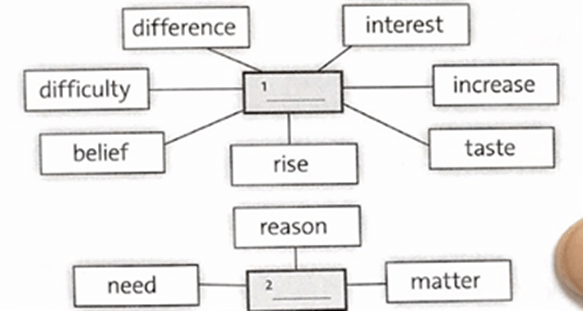
Đáp án:
|
1. in |
2. for |
Hướng dẫn dịch:
difference in: khác
interest in: ưa thích
difficulty in: khó khăn
increase in: tăng
belief in: tin
taste in: khẩu vị
rise in: tăng
need for: nhu cầu
reason for: lý do
matter for: vấn đề
4 (trang 60 SBT Tiếng Anh 12 Friends Global): Complete the sentences with the correct prepositions. (Hoàn thành câu với các giới từ đúng.)
1. Is there really no possibility ______ you changing your mind?
2. This is probably a matter ______ the police.
3. There's a big difference ______ price between taking the bus and getting a taxi.
4. Is your taste ______ clothes the same as your friends'?
5. There's been a sharp rise ______ temperatures this month.
6. The police didn't find any evidence ______ a break-in.
Đáp án:
|
1. of |
2. for |
3. in |
4. in |
5. in |
6. of |
Hướng dẫn dịch:
1. Is there really no possibility of you changing your mind?
(Thực sự không có khả năng cậu sẽ thay đổi quyết định sao?)
2. This is probably a matter for the police.
(Đây có lẽ là vấn đề của cảnh sát.)
3. There's a big difference in price between taking the bus and getting a taxi.
(Có sự khác biệt lớn về giá giữa đi xe buýt và đi taxi.)
4. Is your taste in clothes the same as your friends'?
(Sở thích về quần áo của cậu có giống với bạn bè không?)
5. There's been a sharp rise in temperatures this month.
(Nhiệt độ trong tháng này đã tăng mạnh.)
6. The police didn't find any evidence of a break-in.
(Cảnh sát không tìm thấy bất kỳ bằng chứng nào về vụ đột nhập.)
5 (trang 60 SBT Tiếng Anh 12 Friends Global): Use a dictionary and correct the mistakes with prepositions in the sentences. Tick the two sentences that do not contain any mistakes. (Sử dụng từ điển và sửa lỗi về giới từ trong câu. Hãy đánh dấu vào hai câu không có lỗi sai nào.)
1. No one expected the band to rise in fame so quickly. ____________
2. My cousin's gap year gave her a real taste for travel. ____________
3. Bill and his girlfriend have had a difference in opinion and aren't speaking. ____________
4. You look very pale - is something the matter of you? ____________
5. Customers have recently been experiencing difficulty in using this website. ____________
Đáp án:
|
1. in => to |
2. V |
3. in => of |
4. of => with |
5. V |
Hướng dẫn dịch:
1. No one expected the band to rise to fame so quickly.
(Không ai ngờ nhóm lại nổi tiếng nhanh đến vậy.)
2. My cousin's gap year gave her a real taste for travel.
(Khoảng thời gian nghỉ phép một năm của em họ tớ đã mang đến cho cô ấy niềm đam mê du lịch thực sự.)
3. Bill and his girlfriend have had a difference of opinion and aren't speaking.
(Bill và bạn gái của anh ấy có quan điểm khác nhau và không nói chuyện.)
4. You look very pale - is something the matter with you?
(Trông cậu xanh xao quá - có chuyện gì với bạn vậy?)
5. Customers have recently been experiencing difficulty in using this website.
(Khách hàng gần đây đã gặp khó khăn khi sử dụng trang web này.)
6 (trang 60 SBT Tiếng Anh 12 Friends Global): Complete the sentences with the correct prepositions and your own ideas. (Hoàn thành câu với giới từ đúng và ý tưởng của riêng bạn.)
1. I've never understood the point __________________.
2. Where I live, there's been a rise __________________.
3. Most of my friends have an interest __________________.
4. I wish we could find a solution __________________.
5. I'd love to prove the existence __________________.
6. Nowadays, there's very little demand __________________.
Gợi ý:
1 I've never understood the point of arguing over minor details.
2. Where I live, there's been a rise in housing prices recently.
3. Most of my friends have an interest in traveling and exploring new cultures.
4. I wish we could find a solution to global warming and environmental degradation.
5. I'd love to prove the existence of extraterrestrial life.
6. Nowadays, there's very little demand for handwritten letters.
Hướng dẫn dịch:
1 I've never understood the point of arguing over minor details.
(Tớ chưa bao giờ hiểu ý nghĩa của việc tranh cãi về những chi tiết nhỏ nhặt.)
2. Where I live, there's been a rise in housing prices recently.
(Nơi tớ sống, gần đây giá nhà đất tăng cao.)
3. Most of my friends have an interest in traveling and exploring new cultures.
(Hầu hết bạn bè của tớ đều có sở thích đi du lịch và khám phá những nền văn hóa mới.)
4. I wish we could find a solution to global warming and environmental degradation.
(Tớ ước chúng ta có thể tìm ra giải pháp cho tình trạng nóng lên toàn cầu và suy thoái môi trường.)
5. I'd love to prove the existence of extraterrestrial life.
(Tớ muốn chứng minh sự tồn tại của sự sống ngoài trái đất.)
6. Nowadays, there's very little demand for handwritten letters.
(Ngày nay, nhu cầu viết thư tay rất ít.)
Media wars (Chiến tranh truyền thông)
1 (trang 61 SBT Tiếng Anh 12 Friends Global): Replace the underlined words with the correct form of the phrasal verbs. (Thay thế những từ được gạch chân bằng dạng đúng của cụm động từ.)
find out hole up let on make out
play on set up take in zoom in on
1. I can't believe you were deceived by his tricks!
2. The criminals established false bank accounts.
3. I hate advertising that takes advantage of our fears.
4. Mark told us that he was planning a surprise for Anna.
5. The police discovered what the criminals were planning.
6. The media paid special attention to the government's military plans.
7. He claimed that he was rich, but it wasn't true.
8. The bank robbers were hiding in a friend's house.
Đáp án:
|
1. taken in |
2. set up |
3. plays on |
4. let on |
|
5. found out |
6. zoomed in on |
7. made out |
8. holed up |
Giải thích:
ind out (phr.v): nhận ra
hole up (phr.v): trốn
let on (phr.v): nói
make out (phr.v): tuyên bố
play on (phr.v): lợi dụng
set up (phr.v): thành lập
take in (phr.v): lừa
zoom in on (phr.v): tập trung kĩ vào
Hướng dẫn dịch:
1. I can't believe you were taken in by his tricks!
(Tớ không thể tin rằng cậu đã bị lừa bởi thủ đoạn của anh ấy!)
2. The criminals set up false bank accounts.
(Bọn tội phạm đã thiết lập các tài khoản ngân hàng giả.)
3. I hate advertising that plays on of our fears.
(Tớ ghét những quảng cáo lợi dụng nỗi sợ hãi của chúng ta.)
4. Mark let on that he was planning a surprise for Anna.
(Mark nói với chúng tớ rằng anh ấy đang lên kế hoạch tạo bất ngờ cho Anna.)
5. The police found out what the criminals were planning.
(Cảnh sát đã phát hiện ra những gì bọn tội phạm đang lên kế hoạch.)
6. The media zoomed in on the government's military plans.
(Các phương tiện truyền thông đặc biệt chú ý đến kế hoạch quân sự của chính phủ.)
7. He made out that he was rich, but it wasn't true.
(Anh ta tuyên bố rằng anh ta giàu có, nhưng điều đó không đúng.)
8. The bank robbers were holed up in a friend's house.
(Những tên cướp ngân hàng đang trốn trong nhà một người bạn.)
2 (trang 61 SBT Tiếng Anh 12 Friends Global): Read the text. What does the real story behind The War of the Worlds show us? (Đọc văn bản. Câu chuyện thực sự đằng sau The War of the Worlds cho chúng ta thấy điều gì?)
'Ladies and gentlemen, I have a grave announcement to make. Incredible as it may seem... those strange beings who landed in the Jersey farmlands tonight are... an invading army from the planet Mars'
This announcement in 1934 supposedly scared a million Americans into believing that thousands of their fellow citizens were fighting for their lives against giant aliens. It came from a radio play, read by Orson Welles, that was based on HG Wells's famous 1898 novel The War of the Worlds, and it has become an American media legend. However, as we all know, legends are rarely based on the truth.
The arrival of the radio in the 1930s provided people with an exciting new channel of communication - but it also provided newspapers with unwanted competition. Throughout the decade, more and more people had come to rely on the radio for news, and newspapers had been losing income from advertising. In addition, many people were worried about its possible use as a form of mind control. The War of the Worlds gave newspapers the perfect excuse to exploit these fears and attack their rival as irresponsible. The day after the play was broadcast, newspaper front pages claimed the radio play had caused panic across the country, with people rioting and even committing suicide. However, the stories were fabricated and completely false. Recent research has shown that most people were listening to another radio station that evening, and there are no records of mass hysteria.
It is only now that researchers are realising how the media could fabricate and maintain a lie for nearly a century.
Đáp án:
That the media can invent stories and maintain them for a long time.
Hướng dẫn dịch:
'Thưa quý vị, tôi có một thông báo quan trọng cần đưa ra. Dù có vẻ khó tin... những sinh vật kỳ lạ đã đổ bộ xuống vùng đất nông nghiệp Jersey tối nay là... một đội quân xâm lược từ hành tinh Sao Hỏa'
Thông báo này vào năm 1934 được cho là đã khiến một triệu người Mỹ sợ hãi khi tin rằng hàng nghìn đồng bào của họ đang chiến đấu để giành lấy mạng sống của mình chống lại người ngoài hành tinh khổng lồ. Nó xuất phát từ một vở kịch trên đài phát thanh, do Orson Welles đọc, dựa trên cuốn tiểu thuyết nổi tiếng The War of the Worlds năm 1898 của HG Wells, và nó đã trở thành huyền thoại truyền thông Mỹ. Tuy nhiên, như chúng ta đều biết, truyền thuyết hiếm khi dựa trên sự thật.
Sự xuất hiện của đài phát thanh vào những năm 1930 đã mang đến cho mọi người một kênh liên lạc mới thú vị - nhưng nó cũng mang lại cho báo chí sự cạnh tranh không mong muốn. Trong suốt thập kỷ, ngày càng có nhiều người dựa vào đài phát thanh để biết tin tức và báo chí ngày càng mất thu nhập từ quảng cáo. Ngoài ra, nhiều người lo lắng về việc nó có thể được sử dụng như một hình thức kiểm soát tâm trí. War of the Worlds đã cho các tờ báo một cái cớ hoàn hảo để khai thác những nỗi sợ hãi này và tấn công đối thủ của họ là vô trách nhiệm. Một ngày sau khi vở kịch được phát sóng, các trang nhất báo chí cho rằng vở kịch trên đài đã gây hoảng loạn khắp cả nước, khiến người dân náo loạn và thậm chí tự tử. Tuy nhiên, những câu chuyện đó là bịa đặt và hoàn toàn sai sự thật. Nghiên cứu gần đây đã chỉ ra rằng hầu hết mọi người đều nghe đài phát thanh khác vào buổi tối hôm đó và không có hồ sơ nào về chứng cuồng loạn hàng loạt.
Chỉ đến bây giờ các nhà nghiên cứu mới nhận ra làm thế nào các phương tiện truyền thông có thể bịa đặt và duy trì sự dối trá trong gần một thế kỷ.
3 (trang 61 SBT Tiếng Anh 12 Friends Global): Read the Reading Strategy and the text again and choose the correct answers (a-d). (Đọc lại Chiến lược đọc và bài đọc rồi chọn câu trả lời đúng (a-d).)
1. The announcer on the radio play in 1934
a said American farmers were being attacked.
b suggested that what he was saying was difficult to believe.
c explained that America was invading Mars.
d was suffering from a panic attack.
2. HG Wells's famous novel
a was adapted for the radio.
b deceived millions of people.
c became famous in 1934.
d was about media manipulation.
3. Newspapers didn't like the radio because
a it was more exciting.
b it controlled people.
c it worried people.
d it was a rival for income.
4. The stories in the newspapers about the play
a were based on information from another radio station.
b have been forgotten about today.
c are only being questioned today.
d explained what really happened.
5. The writer wants to show that
a people can be made to believe that they are being attacked by aliens.
b there wasn't enough advertising for both the radio and newspapers in the 1930s.
c the radio and newspapers are enemies.
d the media can create a legend that is not true.
Đáp án:
|
1. b |
2. a |
3. d |
4. c |
5. d |
Giải thích:
1. Thông tin: “'Ladies and gentlemen, I have a grave announcement to make. Incredible as it may seem... those strange beings who landed in the Jersey farmlands tonight are... an invading army from the planet Mars'” ('Thưa quý vị, tôi có một thông báo quan trọng cần đưa ra. Dù có vẻ khó tin... những sinh vật kỳ lạ đã đổ bộ xuống vùng đất nông nghiệp Jersey tối nay là... một đội quân xâm lược từ hành tinh Sao Hỏa')
2. Thông tin: “It came from a radio play, read by Orson Welles, that was based on HG Wells's famous 1898 novel The War of the Worlds, and it has become an American media legend.” (Nó xuất phát từ một vở kịch trên đài phát thanh, do Orson Welles đọc, dựa trên cuốn tiểu thuyết nổi tiếng The War of the Worlds năm 1898 của HG Wells, và nó đã trở thành huyền thoại truyền thông Mỹ.)
3. Thông tin: “Throughout the decade, more and more people had come to rely on the radio for news, and newspapers had been losing income from advertising.” (Trong suốt thập kỷ, ngày càng có nhiều người dựa vào đài phát thanh để biết tin tức và báo chí ngày càng mất thu nhập từ quảng cáo.)
4. Thông tin: “It is only now that researchers are realising how the media could fabricate and maintain a lie for nearly a century.” (Chỉ đến bây giờ các nhà nghiên cứu mới nhận ra làm thế nào các phương tiện truyền thông có thể bịa đặt và duy trì sự dối trá trong gần một thế kỷ.)
5. Thông tin: “However, the stories were fabricated and completely false. Recent research has shown that most people were listening to another radio station that evening, and there are no records of mass hysteria.” (Tuy nhiên, những câu chuyện đó là bịa đặt và hoàn toàn sai sự thật. Nghiên cứu gần đây đã chỉ ra rằng hầu hết mọi người đều nghe đài phát thanh khác vào buổi tối hôm đó và không có hồ sơ nào về chứng cuồng loạn hàng loạt.)
Hướng dẫn dịch:
1. The announcer on the radio play in 1934 suggested that what he was saying was difficult to believe.
(Người dẫn chương trình trên vở kịch phát thanh năm 1934 cho rằng những gì ông ấy nói thật khó tin.)
2. HG Wells's famous novel was adapted for the radio.
(Cuốn tiểu thuyết nổi tiếng của HG Wells đã được chuyển thể thành chương trình phát thanh.)
3. Newspapers didn't like the radio because it was a rival for income.
(Các tờ báo không thích phát thanh vì nó là đối thủ cạnh tranh về thu nhập.)
4. The stories in the newspapers about the play are only being questioned today.
(Những câu chuyện trên báo về vở kịch chỉ mới bị đặt câu hỏi cho đến ngày nay.)
5. The writer wants to show that the media can create a legend that is not true.
(Tác giả muốn chỉ ra rằng phương tiện truyền thông có thể tạo ra một huyền thoại không đúng sự thật.)
Presentation (Bài thuyết trình)
1 (trang 62 SBT Tiếng Anh 12 Friends Global): Read the task above. Then choose the correct option (a or b) in the sentences below. (Đọc nhiệm vụ trên. Sau đó chọn phương án đúng (a hoặc b) trong các câu dưới đây.)
1. The headline refers to how technology can
a cause certain crimes to increase.
b help to fight crime.
2. The photo shows how technology can
a cause certain crimes to increase.
b help to fight crime.
Đáp án:
|
1. a |
2. b |
Hướng dẫn dịch:
1. The headline refers to how technology can cause certain crimes to increase.
(Tiêu đề đề cập đến cách công nghệ có thể khiến một số loại tội phạm gia tăng.)
2. The photo shows how technology can help to fight crime.
(Bức ảnh cho thấy công nghệ có thể giúp chống lại tội phạm như thế nào.)
2 (trang 62 SBT Tiếng Anh 12 Friends Global): Listen to a student doing the task. Which of the topics below does he mention? (Lắng nghe một học sinh làm bài. Anh ấy đề cập đến chủ đề nào dưới đây?)
Bài nghe:
artificial intelligence car crime computers credit cards
email scams mobile phones television
Đáp án:
3 topics he mentiones: car crime, email scams, mobile phones
Nội dung bài nghe:
Email scams are a good example of people using technology to commit crime. The kind of thing I’m talking about is an email saying you’ve won millions in a lottery. Of course, they just want your bank details!
Car manufacturers use technology to combat theft. So, for instance, cars are much harder to steal these days. Car keys are very high-tech. But if you understand the technology, stealing cars is actually easier. In other words, criminals can use their knowledge of technology to commit crimes. Surveillance cameras help to reduce crime, even if they aren’t recording. What I mean by that is: people don’t commit crimes if there are cameras about. However, criminals can always find somewhere without cameras. Or to put it another way, crime doesn’t stop, it just moves to another area.
Some high-tech items have a positive and a negative effect on crime. One example of that would be the mobile phone. They often get stolen, but on the other hand, they can be used to video important evidence or call for help.
Giải thích:
artificial intelligence: trí tuệ nhân tạo
car crime: tội phạm xe hơi
computers: máy tính
credit cards: thẻ tín dụng
email scams: lừa đảo qua email
mobile phones: điện thoại di động
television: TV
Hướng dẫn dịch:
Lừa đảo qua email là một ví dụ điển hình về việc mọi người sử dụng công nghệ để phạm tội. Điều tôi đang nói đến là một email nói rằng bạn đã trúng số hàng triệu USD. Tất nhiên, họ chỉ muốn chi tiết ngân hàng của bạn!
Các nhà sản xuất ô tô sử dụng công nghệ để chống trộm. Vì vậy, ví dụ, ô tô ngày nay khó bị đánh cắp hơn nhiều. Chìa khóa xe rất công nghệ cao. Nhưng nếu bạn hiểu rõ về công nghệ thì việc trộm xe thực ra còn dễ dàng hơn. Nói cách khác, tội phạm có thể sử dụng kiến thức về công nghệ để phạm tội. Camera giám sát giúp giảm tội phạm, ngay cả khi chúng không ghi hình. Ý tôi muốn nói là: mọi người không phạm tội nếu có camera ở xung quanh. Tuy nhiên, bọn tội phạm luôn có thể tìm thấy nơi nào đó không có camera. Hay nói cách khác, tội phạm không dừng lại mà nó chỉ di chuyển sang khu vực khác.
Một số mặt hàng công nghệ cao có tác động tích cực và tiêu cực đến tội phạm. Một ví dụ về điều đó sẽ là điện thoại di động. Chúng thường bị đánh cắp, nhưng mặt khác, chúng có thể được sử dụng để quay video bằng chứng quan trọng hoặc kêu gọi trợ giúp.
3 (trang 62 SBT Tiếng Anh 12 Friends Global): Read the Speaking Strategy. Then complete the phrases for introducing extra information and examples with the words below. (Đọc Chiến lược nói. Sau đó hoàn thành các cụm từ để giới thiệu thông tin bổ sung và ví dụ với các từ bên dưới.)
instance kind that what words
a. One example of _______ would be...
b. So, for _______,…
c. _______ I mean by that is...
d. The _______ of thing I'm talking about is...
e. In other _______,…
Đáp án:
a. One example of that would be...
b. So, for instance,…
c. What I mean by that is...
d. The kind of thing I'm talking about is...
e. In other words,…
Hướng dẫn dịch:
One example of that would be... = một ví dụ về điều đó là ...
So, for instance,… = Vì vậy, ví dụ như, ...
What I mean by that is... = Ý tôi là ....
The kind of thing I'm talking about is... = Điều tôi đang nói đến là ...
In other words,… = Nói cách khác, ....
4 (trang 62 SBT Tiếng Anh 12 Friends Global): Listen again. Complete these sentences from the student's presentation with the correct phrases from exercise 3. Write (a-e). (Lắng nghe một lần nữa. Hoàn thành các câu trong phần trình bày của học sinh bằng các cụm từ đúng trong bài tập 3. Viết (a-e).)
Bài nghe:
1. ___ an email saying you've won millions in a lottery.
2. ___ cars are much harder to steal these days.
3. ___ criminals can use their knowledge of technology to commit crimes.
4. ___ people don't commit crimes if there are cameras about.
5. ___ the mobile phone.
Đáp án:
|
1. d |
2. b |
3. e |
4. c |
5. a |
Hướng dẫn dịch:
1. The kind of thing I'm talking about is an email saying you've won millions in a lottery.
(Điều tớ đang nói đến là một email nói rằng cậu đã trúng xổ số hàng triệu đô la.)
2. So, for instance, cars are much harder to steal these days.
(Vì vậy, ví dụ, ô tô ngày nay khó bị đánh cắp hơn nhiều.)
3. In other words, criminals can use their knowledge of technology to commit crimes.
(Nói cách khác, tội phạm có thể sử dụng kiến thức về công nghệ để phạm tội.)
4. What I mean by that is people don't commit crimes if there are cameras about.
(Ý tôi là mọi người không phạm tội nếu có camera ở đó.)
5. One example of that would be the mobile phone.
(Một ví dụ về điều đó sẽ là điện thoại di động.)
5 (trang 62 SBT Tiếng Anh 12 Friends Global): Read the task above. Then make notes under the headings below. (Đọc nhiệm vụ trên. Sau đó ghi chú theo các tiêu đề bên dưới.)
A social media campaign using the hashtag #nomakeupselfie has raised £8 million for charity in just six days. Huge numbers of women, including many celebrities, have posted photos of themselves wearing no make-up and nominated friends to do the same. At the same time, they encourage thei friends to donate money to Cancer Research UK. However, the campaign was started by an individual, not by Cancer Research, and shows how social media can be a force for good.
Half of all young people say cyberbullying is part of everyday life as majority of parents admit they are scared for their children online.
Examples of how friendships are strengthened
______________________________________
Examples of cyberbullying / lies
______________________________________
Examples of how social media campaigns can make a difference
______________________________________
Đáp án:
Examples of how friendships are strengthened
Building communities: People with similar interests or experiences can find each other and create supportive communities online.
Instant communication: Social media platforms enable quick and easy communication, helping friends stay in touch regardless of physical distance.
Examples of cyberbullying / lies
Spreading false information: Lies and rumors can spread quickly on social media, damaging reputations and causing emotional distress.
Peer pressure: Social media can create unrealistic standards and pressure individuals to conform, leading to negative self-esteem and mental health issues.
Examples of how social media campaigns can make a difference
Fundraising for charities: Campaigns like the #nomakeupselfie have raised significant amounts of money for various causes, such as Cancer Research UK.
Raising awareness: Social media campaigns can bring attention to important issues, mobilizing people to take action or change their behavior.
Hướng dẫn dịch:
Examples of how friendships are strengthened (Ví dụ về cách củng cố tình bạn)
Building communities: People with similar interests or experiences can find each other and create supportive communities online. (Xây dựng cộng đồng: Những người có cùng sở thích hoặc trải nghiệm có thể tìm thấy nhau và tạo cộng đồng hỗ trợ trực tuyến.)
Instant communication: Social media platforms enable quick and easy communication, helping friends stay in touch regardless of physical distance. (Giao tiếp tức thì: Nền tảng truyền thông xã hội cho phép liên lạc nhanh chóng và dễ dàng, giúp bạn bè giữ liên lạc bất kể khoảng cách địa lý.)
Examples of cyberbullying / lies (Ví dụ về bắt nạt trên mạng/lời nói dối)
Spreading false information: Lies and rumors can spread quickly on social media, damaging reputations and causing emotional distress. (Truyền bá thông tin sai lệch: Những lời nói dối và tin đồn có thể lan truyền nhanh chóng trên mạng xã hội, gây tổn hại đến danh tiếng và gây đau khổ về tinh thần.)
Peer pressure: Social media can create unrealistic standards and pressure individuals to conform, leading to negative self-esteem and mental health issues. (Áp lực từ bạn bè: Phương tiện truyền thông xã hội có thể tạo ra các tiêu chuẩn phi thực tế và gây áp lực buộc các cá nhân phải tuân theo, dẫn đến lòng tự trọng tiêu cực và các vấn đề về sức khỏe tâm thần.)
Examples of how social media campaigns can make a difference (Ví dụ về cách các chiến dịch truyền thông xã hội có thể tạo ra sự khác biệt)
Fundraising for charities: Campaigns like the #nomakeupselfie have raised significant amounts of money for various causes, such as Cancer Research UK. (Gây quỹ cho các tổ chức từ thiện: Các chiến dịch như #nomakeupselfie đã quyên góp được số tiền đáng kể vì nhiều mục đích khác nhau, chẳng hạn như tổ chức Nghiên cứu Ung thư Vương quốc Anh.)
Raising awareness: Social media campaigns can bring attention to important issues, mobilizing people to take action or change their behavior. (Nâng cao nhận thức: Các chiến dịch truyền thông xã hội có thể gây sự chú ý đến các vấn đề quan trọng, huy động mọi người hành động hoặc thay đổi hành vi.)
6 (trang 62 SBT Tiếng Anh 12 Friends Global): Now do the task using your notes from exercise 5. Remember to include phrases from exercise 3. (Bây giờ hãy làm bài tập bằng cách sử dụng ghi chú của bài tập 5. Hãy nhớ thêm các cụm từ ở bài tập 3.)
Gợi ý:
Social media has a significant impact on people's lives, both positively and negatively. One example of that would be how it strengthens friendships and networks. People with similar interests can find each other and create supportive communities online. So, for instance, forums and groups on platforms like Reddit or Facebook help individuals find others who share their hobbies. Social media enables quick communication, helping friends stay in touch regardless of distance. The kind of thing I'm talking about is using apps like WhatsApp to chat with friends daily.
However, social media also has downsides, such as cyberbullying and spreading lies. Lies and rumors can spread quickly, damaging reputations and causing emotional distress. In other words, misinformation can be shared widely, leading to false beliefs. Social media creates unrealistic standards and pressures individuals to conform, affecting self-esteem and mental health. What I mean by that is feeling pressured to post perfect photos to gain likes.
On the positive side, social media campaigns can make a difference. Campaigns like the #nomakeupselfie have raised significant amounts for causes like Cancer Research UK. One example of that would be the ALS Ice Bucket Challenge, which went viral and raised millions. Social media campaigns bring attention to important issues, prompting action and change. So, for instance, the #MeToo movement highlighted issues of harassment, leading to widespread conversations and changes.
In conclusion, while social media has challenges like cyberbullying, it also offers benefits like strengthening friendships, raising awareness, and supporting charitable causes.
Hướng dẫn dịch:
Social media has a significant impact on people's lives, both positively and negatively. One example of that would be how it strengthens friendships and networks. People with similar interests can find each other and create supportive communities online. So, for instance, forums and groups on platforms like Reddit or Facebook help individuals find others who share their hobbies. Social media enables quick communication, helping friends stay in touch regardless of distance. The kind of thing I'm talking about is using apps like WhatsApp to chat with friends daily.
However, social media also has downsides, such as cyberbullying and spreading lies. Lies and rumors can spread quickly, damaging reputations and causing emotional distress. In other words, misinformation can be shared widely, leading to false beliefs. Social media creates unrealistic standards and pressures individuals to conform, affecting self-esteem and mental health. What I mean by that is feeling pressured to post perfect photos to gain likes.
On the positive side, social media campaigns can make a difference. Campaigns like the #nomakeupselfie have raised significant amounts for causes like Cancer Research UK. One example of that would be the ALS Ice Bucket Challenge, which went viral and raised millions. Social media campaigns bring attention to important issues, prompting action and change. So, for instance, the #MeToo movement highlighted issues of harassment, leading to widespread conversations and changes.
In conclusion, while social media has challenges like cyberbullying, it also offers benefits like strengthening friendships, raising awareness, and supporting charitable causes.
(Phương tiện truyền thông xã hội có tác động đáng kể đến cuộc sống của mọi người, cả tích cực và tiêu cực. Một ví dụ về điều đó là cách nó củng cố tình bạn và mạng lưới. Những người có cùng sở thích có thể tìm thấy nhau và tạo cộng đồng hỗ trợ trực tuyến. Vì vậy, ví dụ: các diễn đàn và nhóm trên các nền tảng như Reddit hoặc Facebook giúp các cá nhân tìm thấy những người khác có cùng sở thích với họ. Phương tiện truyền thông xã hội cho phép liên lạc nhanh chóng, giúp bạn bè giữ liên lạc bất kể khoảng cách. Điều tôi đang nói đến là sử dụng các ứng dụng như WhatsApp để trò chuyện với bạn bè hàng ngày.
Tuy nhiên, mạng xã hội cũng có những nhược điểm, chẳng hạn như bắt nạt trên mạng và lan truyền những lời dối trá. Những lời dối trá và tin đồn có thể lan truyền nhanh chóng, gây tổn hại đến danh tiếng và gây đau khổ về tinh thần. Nói cách khác, thông tin sai lệch có thể được chia sẻ rộng rãi, dẫn đến niềm tin sai lệch. Phương tiện truyền thông xã hội tạo ra các tiêu chuẩn phi thực tế và gây áp lực buộc các cá nhân phải tuân thủ, ảnh hưởng đến lòng tự trọng và sức khỏe tâm thần. Ý tôi là điều đó là cảm giác bị áp lực phải đăng những bức ảnh hoàn hảo để đạt được lượt thích.
Về mặt tích cực, các chiến dịch truyền thông xã hội có thể tạo ra sự khác biệt. Các chiến dịch như #nomakeupselfie đã quyên góp được số tiền đáng kể cho các mục đích như Nghiên cứu Ung thư Vương quốc Anh. Một ví dụ về điều đó là Thử thách xô đá ALS, đã lan truyền và thu hút được hàng triệu người. Các chiến dịch truyền thông xã hội thu hút sự chú ý đến các vấn đề quan trọng, thúc đẩy hành động và thay đổi. Vì vậy, chẳng hạn, phong trào #MeToo đã nêu bật các vấn đề quấy rối, dẫn đến các cuộc đối thoại và thay đổi rộng rãi.
Tóm lại, mặc dù mạng xã hội có những thách thức như bắt nạt qua mạng nhưng nó cũng mang lại những lợi ích như củng cố tình bạn, nâng cao nhận thức và hỗ trợ các hoạt động từ thiện.)
A table (Một bảng thông tin)
1 (trang 63 SBT Tiếng Anh 12 Friends Global): Read the task and the summary below. Does the writer (Đọc bài tập và phần tóm tắt bên dưới. Tác giả có)
include every detail in the table?
• give any prediction for the future trend?
• follow the instruction of the word limit?
Technology usage in Youth City overtime
|
2005 |
2010 |
2015 |
|
|
Own a smartphone |
2% |
50% |
78% |
|
Own a tablet |
4% |
46% |
|
|
Own a smart watch |
2% |
5% |
The table above shows the data for the population in Youth City owning technology devices in 2005, 2010 and 2015. In about 120-150 words, summarise the information in the table.
The table presents the percentage of population owning technology devices in Youth City in three years 2005, 2010 and 2015. In general, there was an increase in the number of people owning 3 types of electronic devices throughout 10 years. Among the three devices, the smartphone was the most popularly used, and the smart watch was the latest and the least to be owned and used. As seen from the figure in 2010, fifty percent of the population in the city owned a smartphone, while a smart watch was first introduced and used by only 2 percent. In 2005, just 2 percent of the population of the city owned a smartphone, but in 2015, the number of users became nearly 40 times of that (78%). The owning of a tablet was rapidly increasing, rising from 4 percent to 46 percent within 5 years from 2010 to 2015. In contrast, the possession of a smart watch did not make a steady rise, rising only 3 percent within 5 years.
Đáp án:
The writer
- does not include every detail in the table.
- does not give any prediction for the future trend.
- follows the instruction of the word limit.
Hướng dẫn dịch:
Bảng trình bày tỷ lệ dân số sở hữu thiết bị công nghệ tại Thành phố Youth trong 3 năm 2005, 2010 và 2015. Nhìn chung, số lượng người sở hữu 3 loại thiết bị điện tử đều tăng trong suốt 10 năm. Trong số ba thiết bị, điện thoại thông minh được sử dụng phổ biến nhất và đồng hồ thông minh là thiết bị mới nhất và ít được sở hữu và sử dụng nhất. Theo số liệu năm 2010, 50% dân số thành phố sở hữu điện thoại thông minh, trong khi đồng hồ thông minh lần đầu tiên được giới thiệu và sử dụng chỉ có 2%. Năm 2005, chỉ 2% dân số thành phố sở hữu điện thoại thông minh, nhưng đến năm 2015, số lượng người dùng đã tăng gần 40 lần con số đó (78%). Tỷ lệ sở hữu máy tính bảng tăng nhanh, từ 4% lên 46% trong vòng 5 năm từ 2010 đến 2015. Ngược lại, việc sở hữu đồng hồ thông minh không tăng đều đặn, chỉ tăng 3% trong vòng 5 năm.
2 (trang 63 SBT Tiếng Anh 12 Friends Global): Read Writing Strategy. Did the writer follow the strategy? (Đọc Chiến lược viết. Người viết có làm theo chiến lược không?)
• Pick out the detail in the summary showing a comparison.
• Which detail in the summary would you like to leave out?
• Which detail in the table would you like to add in?
Đáp án:
The writer follows the strategy. Examples:
- As seen from the figure in 2010, fifty percent of the population in the city owned a smartphone, while a smart watch was first introduced and used by only 2 percent
- The detail which can be left out: the number of users became nearly 40 times of that.
- The idea which could be added in: People used neither tablet nor smart watch in 2005.
Hướng dẫn dịch:
The writer follows the strategy. Examples:
- As seen from the figure in 2010, fifty percent of the population in the city owned a smartphone, while a smart watch was first introduced and used by only 2 percent
- The detail which can be left out: the number of users became nearly 40 times of that.
- The idea which could be added in: People used neither tablet nor smart watch in 2005.
(Người viết tuân theo chiến lược. Ví dụ:
- Theo số liệu năm 2010, 50% dân số thành phố sở hữu điện thoại thông minh, trong khi đồng hồ thông minh lần đầu tiên được giới thiệu và sử dụng chỉ có 2%
- Chi tiết có thể bỏ qua: số lượng người dùng đã tăng gần 40 lần.
- Ý tưởng có thể được bổ sung: Mọi người không sử dụng máy tính bảng hay đồng hồ thông minh vào năm 2005.)
3 (trang 63 SBT Tiếng Anh 12 Friends Global): KEY PHRASES Put the following phrases in the correct groups. (Xếp các cụm từ sau vào đúng nhóm.)
• This table is a representation of the process for ...
• There has been a sharp rise in the amount of...
• On the contrary, the figure of...
• This table uses data from the Z Database.
• The table gives information...
• Another detail worth discussing is...
• Compared to .....
Introducing the table .....
Giving remarks .....
Đáp án:
|
Introducing the table |
Giving remarks |
|
- This table is a representation of the process for … - The table gives information … - This table uses data from the Z Database. |
- There has been a sharp rise in the amount of … - On the contrary, the figure of … - Another detail worth discussing is … - Compared to …, … |
Hướng dẫn dịch
|
Introducing the table (Giới thiệu bảng) |
Giving remarks (Đưa ra nhận xét) |
|
- This table is a representation of the process for … (Bảng này thể hiện quy trình của…) - The table gives information … (Bảng cung cấp thông tin…) - This table uses data from the Z Database. (Bảng này sử dụng dữ liệu từ Z Database.) |
- There has been a sharp rise in the amount of … (Số lượng đã tăng mạnh…) - On the contrary, the figure of … (Ngược lại, số liệu của…) - Another detail worth discussing is … (Một chi tiết nữa đáng bàn là…) - Compared to …, … (So với …, …) |
4 (trang 63 SBT Tiếng Anh 12 Friends Global): Read the Writing Strategy again and the task below. Make notes under the headings. (Đọc lại Chiến lược viết và bài tập bên dưới. Ghi chú dưới các tiêu đề.)
The table below shows the data for the percentage of students in Youth City using the internet for their study from 2019 to 2021. In about 120-150 words, summarise the information in the table.
Using the internet for studying 2019-2021
|
2019 |
2020 |
2021 |
|
|
Read online material |
5% |
18% |
54% |
|
Attend online courses |
3% |
23% |
80% |
|
Do online tests and exams |
1% |
20% |
76% |
What to include in the introduction:
What? / Where? / When?
What to include in the remarks:
In general,...
The highest / The lowest percentage…
Đáp án:
What to include in the introduction:
- How students use the internet for their study
- In Youth City
- From 2019 to 2021
What to include in the remarks:
In general, the percentage of students using the internet for three activities was on steady increase from 2019 to 2021.
Although in 2019 the percentage of the students attending online courses took up only 3%, it soared up to 80% in 2021, the highest percentage in the table (among the three activities).
In 2019, the lowest percentage was the students doing online tests and exams. However, in 2021, the lowest switched to the activity of reading online (just 54%). The activity of reading online in 2021 accounted for 54% of the students, three times of the percentage in 2020.
Hướng dẫn dịch:
What to include in the introduction: (Nội dung cần đưa vào phần giới thiệu:)
- How students use the internet for their study
- In Youth City
- From 2019 to 2021
(- Cách học sinh sử dụng Internet để học tập
- Tại Thành Phố Tuổi Trẻ
- Từ năm 2019 đến năm 2021)
What to include in the remarks: (Những gì cần bao gồm trong nhận xét:)
In general, the percentage of students using the internet for three activities was on steady increase from 2019 to 2021.
Although in 2019 the percentage of the students attending online courses took up only 3%, it soared up to 80% in 2021, the highest percentage in the table (among the three activities).
In 2019, the lowest percentage was the students doing online tests and exams. However, in 2021, the lowest switched to the activity of reading online (just 54%). The activity of reading online in 2021 accounted for 54% of the students, three times of the percentage in 2020.
(Nhìn chung, tỷ lệ học sinh sử dụng internet cho ba hoạt động tăng đều đặn từ năm 2019 đến năm 2021.
Mặc dù năm 2019 tỷ lệ sinh viên tham gia các khóa học trực tuyến chỉ chiếm 3% nhưng con số này đã tăng lên tới 80% vào năm 2021, tỷ lệ cao nhất trong bảng (trong ba hoạt động).
Năm 2019, tỷ lệ thấp nhất là học sinh làm bài kiểm tra, thi trực tuyến. Tuy nhiên, vào năm 2021, tỷ lệ thấp nhất chuyển sang hoạt động đọc sách trực tuyến (chỉ 54%). Hoạt động đọc sách trực tuyến năm 2021 chiếm 54% số học sinh, gấp 3 lần tỷ lệ năm 2020.)
5 (trang 63 SBT Tiếng Anh 12 Friends Global): Write the summary of the table. (Viết tóm tắt bảng.)
Gợi ý:
The table reveals a remarkable shift in how students in Youth City utilized the internet for educational purposes from 2019 to 2021. Initially, in 2019, only 5% engaged in reading online material, 3% attended online courses, and merely 1% took online tests and exams. By 2020, these figures surged: 18% for reading online, 23% for attending online courses, and 20% for online tests and exams. The trend accelerated further in 2021, with 54% of students reading online, 80% participating in online courses, and 76% conducting tests and exams online. Particularly noteworthy was the extraordinary rise in online course participation, climbing from 3% in 2019 to 80% in 2021, marking the highest percentage among all activities surveyed. Conversely, the lowest percentage shifted from online tests and exams in 2019 (1%) to reading online material in 2021 (54%), still showing significant growth compared to previous years. Overall, the data underscores a substantial increase in internet reliance for academic purposes among Youth City students over the three-year period.
Hướng dẫn dịch:
The table reveals a remarkable shift in how students in Youth City utilized the internet for educational purposes from 2019 to 2021. Initially, in 2019, only 5% engaged in reading online material, 3% attended online courses, and merely 1% took online tests and exams. By 2020, these figures surged: 18% for reading online, 23% for attending online courses, and 20% for online tests and exams. The trend accelerated further in 2021, with 54% of students reading online, 80% participating in online courses, and 76% conducting tests and exams online. Particularly noteworthy was the extraordinary rise in online course participation, climbing from 3% in 2019 to 80% in 2021, marking the highest percentage among all activities surveyed. Conversely, the lowest percentage shifted from online tests and exams in 2019 (1%) to reading online material in 2021 (54%), still showing significant growth compared to previous years. Overall, the data underscores a substantial increase in internet reliance for academic purposes among Youth City students over the three-year period.
(Bảng này cho thấy sự thay đổi đáng chú ý trong cách học sinh ở Thành phố Youth sử dụng Internet cho mục đích giáo dục từ năm 2019 đến năm 2021. Ban đầu, vào năm 2019, chỉ 5% tham gia đọc tài liệu trực tuyến, 3% tham gia các khóa học trực tuyến và chỉ 1% làm bài kiểm tra trực tuyến và các kỳ thi. Đến năm 2020, những con số này tăng vọt: 18% dành cho việc đọc trực tuyến, 23% dành cho việc tham gia các khóa học trực tuyến và 20% dành cho các bài kiểm tra và bài thi trực tuyến. Xu hướng này còn tăng tốc hơn nữa vào năm 2021, với 54% sinh viên đọc trực tuyến, 80% tham gia các khóa học trực tuyến và 76% thực hiện các bài kiểm tra và bài kiểm tra trực tuyến. Đặc biệt đáng chú ý là tỷ lệ tham gia khóa học trực tuyến tăng đột biến, từ 3% năm 2019 lên 80% vào năm 2021, đánh dấu tỷ lệ cao nhất trong số tất cả các hoạt động được khảo sát. Ngược lại, tỷ lệ thấp nhất chuyển từ kiểm tra và thi trực tuyến vào năm 2019 (1%) sang đọc tài liệu trực tuyến vào năm 2021 (54%), vẫn cho thấy mức tăng trưởng đáng kể so với các năm trước. Nhìn chung, dữ liệu nhấn mạnh sự gia tăng đáng kể về mức độ phụ thuộc vào Internet cho mục đích học tập của sinh viên Thành phố Youth trong thời gian ba năm.)
Xem thêm các chương trình khác:
- Soạn văn 12 Chân trời sáng tạo (hay nhất)
- Văn mẫu 12 - Chân trời sáng tạo
- Tóm tắt tác phẩm Ngữ văn 12 – Chân trời sáng tạo
- Tác giả tác phẩm Ngữ văn 12 - Chân trời sáng tạo
- Bố cục tác phẩm Ngữ văn 12 – Chân trời sáng tạo
- Nội dung chính tác phẩm Ngữ văn 12 – Chân trời sáng tạo
- Giải Chuyên đề học tập Ngữ văn 12 – Chân trời sáng tạo
- Giải sgk Toán 12 – Chân trời sáng tạo
- Giải Chuyên đề học tập Toán 12 – Chân trời sáng tạo
- Lý thuyết Toán 12 – Chân trời sáng tạo
- Giải sbt Toán 12 – Chân trời sáng tạo
- Giải sgk Lịch sử 12 – Chân trời sáng tạo
- Giải Chuyên đề học tập Lịch sử 12 – Chân trời sáng tạo
- Giải sbt Lịch sử 12 – Chân trời sáng tạo
- Lý thuyết Lịch sử 12 – Chân trời sáng tạo
- Giải sgk Địa lí 12 – Chân trời sáng tạo
- Giải Chuyên đề học tập Địa lí 12 – Chân trời sáng tạo
- Giải sbt Địa lí 12 – Chân trời sáng tạo
- Lý thuyết Địa lí 12 – Chân trời sáng tạo
- Giải sgk Tin học 12 – Chân trời sáng tạo
- Giải Chuyên đề học tập Tin học 12 – Chân trời sáng tạo
- Giải sbt Tin học 12 – Chân trời sáng tạo
- Lý thuyết Tin học 12 - Chân trời sáng tạo
- Giải sgk Công nghệ 12 – Chân trời sáng tạo
- Giải sgk Kinh tế pháp luật 12 – Chân trời sáng tạo
- Giải Chuyên đề học tập Kinh tế pháp luật 12 – Chân trời sáng tạo
- Giải sbt Kinh tế pháp luật 12 – Chân trời sáng tạo
- Giải sgk Giáo dục quốc phòng 12 – Chân trời sáng tạo
- Giải sgk Hoạt động trải nghiệm 12 – Chân trời sáng tạo
- Giải sgk Vật lí 12 – Chân trời sáng tạo
- Giải Chuyên đề học tập Vật lí 12 – Chân trời sáng tạo
- Lý thuyết Vật lí 12 – Chân trời sáng tạo
- Giải sbt Vật lí 12 – Chân trời sáng tạo
- Giải sgk Hóa học 12 – Chân trời sáng tạo
- Giải Chuyên đề học tập Hóa 12 – Chân trời sáng tạo
- Lý thuyết Hóa 12 – Chân trời sáng tạo
- Giải sbt Hóa 12 – Chân trời sáng tạo
- Giải sgk Sinh học 12 – Chân trời sáng tạo
- Giải Chuyên đề học tập Sinh học 12 – Chân trời sáng tạo
- Lý thuyết Sinh học 12 – Chân trời sáng tạo
- Giải sbt Sinh học 12 – Chân trời sáng tạo