Danh sách câu hỏi

Có 3,592 câu hỏi trên 90 trang

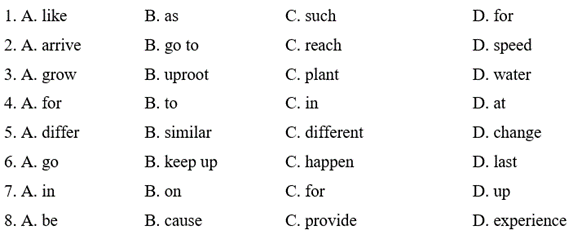
About twenty percent of the world’s present energy already (1)..... from the sun in one form or another. Special devices have already been made (2)..... to place on the roofs of houses and flats to (3)..... the sun’s rays. Thousands of these devices are now being used to provide (4).... in homes throughout the United State (5).... more than a million solar (6)... units have already been built in home in Japan. Other purposes (7)... which solar energy is at present being used include the (8)... of salt from seawater, irrigation and sewage disposal.

For most people in developing countries, the (9)... is not for airconditioners or central heating (10)... for cheap ways of cooking food, drying crops and lighting homes.

1, A.goes            B.comes             C.makes             D.supplies

2, A.difficult             B.effective             C.available             D.valuable

3, A.collect             B.store             C.give off             D.produce

4, A.electricity             B.source             C.fuel             D.power

5, A.where             B.when             C.while             D.which

6, A.water-heat             B.water-heating             C.heat-water             D.heat-watering

7, A.for             B.at             C.from             D.by

8, A.relation             B.production             C.provision             D.separation

9, A.supply             B.lack             C.need             D.response

10, A.then             B.but             C.as             D.also

Read the passage carefully, then choose the correct option (marked A, B, C or D) to answer the questions.

A recent survey of crime statistics shows that we are all more likely to be burgled now than 20 years ago and the police advise everyone to take a few simple precautions to protect their homes.

The first fact is that burglars and other intruders prefer easy opportunities, like a house which is very obviously empty. This is much less of a challenge than an occupied house, and one which is well-protected. A burglar will wonder if it is worth the bother.

There are some general tips on how to avoid your home becoming another crime statistic. Avoid leaving signs that your house is empty. When you have to go out, leave at least one light on as well as a radio or television, and do not leave any curtains wide open. The sight of your latest music centre or computer is enough to tempt any burglar.

Never leave a spare key in a convenient hiding place. The first place a burglar will look is under the doormat or in a flower pot and even somewhere more 'imaginative' could soon be uncovered by the intruder. It is much safer to leave a key with a neighbor you can trust. But if your house is in a quiet, desolate area be aware that this will be a burglar's dream, so deter any potential criminal from approaching your house by fitting security lights to the outside of your house.

But what could happen if, in spite of the aforementioned precautions, a burglar or intruder has decided to target your home? Windows are usually the first point of entry for many intruders. Downstairs windows provide easy access while upstairs windows can be reached with a ladder or by climbing up the drainpipe. Before going to bed you should double-check that all windows and shutters are locked. No matter how small your windows may be, it is surprising what a narrow gap a determined burglar can manage to get through. For extra security, fit window locks to the inside of the window.

What about entry via doors? Your back door and patio doors, which are easily forced open, should have top quality security locks fitted. Even though this is expensive it will be money well spent. Install a burglar alarm if you can afford it as another line of defence against intruders.

A sobering fact is that not all intruders have to break and enter into a property. Why go to the trouble of breaking in if you can just knock and be invited in? Beware of bogus officials or workmen and, particularly if you are elderly, fit a chain and an eye hole so you can scrutinize callers at your leisure. When you do have callers never let anybody into your home unless you are absolutely sure they are genuine. Ask to see an identity card, for example.

If you are in the frightening position of waking in the middle of the night and think you can hear an intruder, then on no account should you approach the intruder. Far better to telephone the police and wait for help.

5. The writer argues that fitting a chain and an eye hole _______.

Read the passage carefully, then choose the correct option (marked A, B, C or D) to answer the questions.

A recent survey of crime statistics shows that we are all more likely to be burgled now than 20 years ago and the police advise everyone to take a few simple precautions to protect their homes.

The first fact is that burglars and other intruders prefer easy opportunities, like a house which is very obviously empty. This is much less of a challenge than an occupied house, and one which is well-protected. A burglar will wonder if it is worth the bother.

There are some general tips on how to avoid your home becoming another crime statistic. Avoid leaving signs that your house is empty. When you have to go out, leave at least one light on as well as a radio or television, and do not leave any curtains wide open. The sight of your latest music centre or computer is enough to tempt any burglar.

Never leave a spare key in a convenient hiding place. The first place a burglar will look is under the doormat or in a flower pot and even somewhere more 'imaginative' could soon be uncovered by the intruder. It is much safer to leave a key with a neighbor you can trust. But if your house is in a quiet, desolate area be aware that this will be a burglar's dream, so deter any potential criminal from approaching your house by fitting security lights to the outside of your house.

But what could happen if, in spite of the aforementioned precautions, a burglar or intruder has decided to target your home? Windows are usually the first point of entry for many intruders. Downstairs windows provide easy access while upstairs windows can be reached with a ladder or by climbing up the drainpipe. Before going to bed you should double-check that all windows and shutters are locked. No matter how small your windows may be, it is surprising what a narrow gap a determined burglar can manage to get through. For extra security, fit window locks to the inside of the window.

What about entry via doors? Your back door and patio doors, which are easily forced open, should have top quality security locks fitted. Even though this is expensive it will be money well spent. Install a burglar alarm if you can afford it as another line of defence against intruders.

A sobering fact is that not all intruders have to break and enter into a property. Why go to the trouble of breaking in if you can just knock and be invited in? Beware of bogus officials or workmen and, particularly if you are elderly, fit a chain and an eye hole so you can scrutinize callers at your leisure. When you do have callers never let anybody into your home unless you are absolutely sure they are genuine. Ask to see an identity card, for example.

If you are in the frightening position of waking in the middle of the night and think you can hear an intruder, then on no account should you approach the intruder. Far better to telephone the police and wait for help.

4. According to the writer, window locks, security locks and burglar alarms _______.

Read the passage carefully, then choose the correct option (marked A, B, C or D) to answer the questions.

A recent survey of crime statistics shows that we are all more likely to be burgled now than 20 years ago and the police advise everyone to take a few simple precautions to protect their homes.

The first fact is that burglars and other intruders prefer easy opportunities, like a house which is very obviously empty. This is much less of a challenge than an occupied house, and one which is well-protected. A burglar will wonder if it is worth the bother.

There are some general tips on how to avoid your home becoming another crime statistic. Avoid leaving signs that your house is empty. When you have to go out, leave at least one light on as well as a radio or television, and do not leave any curtains wide open. The sight of your latest music centre or computer is enough to tempt any burglar.

Never leave a spare key in a convenient hiding place. The first place a burglar will look is under the doormat or in a flower pot and even somewhere more 'imaginative' could soon be uncovered by the intruder. It is much safer to leave a key with a neighbor you can trust. But if your house is in a quiet, desolate area be aware that this will be a burglar's dream, so deter any potential criminal from approaching your house by fitting security lights to the outside of your house.

But what could happen if, in spite of the aforementioned precautions, a burglar or intruder has decided to target your home? Windows are usually the first point of entry for many intruders. Downstairs windows provide easy access while upstairs windows can be reached with a ladder or by climbing up the drainpipe. Before going to bed you should double-check that all windows and shutters are locked. No matter how small your windows may be, it is surprising what a narrow gap a determined burglar can manage to get through. For extra security, fit window locks to the inside of the window.

What about entry via doors? Your back door and patio doors, which are easily forced open, should have top quality security locks fitted. Even though this is expensive it will be money well spent. Install a burglar alarm if you can afford it as another line of defence against intruders.

A sobering fact is that not all intruders have to break and enter into a property. Why go to the trouble of breaking in if you can just knock and be invited in? Beware of bogus officials or workmen and, particularly if you are elderly, fit a chain and an eye hole so you can scrutinize callers at your leisure. When you do have callers never let anybody into your home unless you are absolutely sure they are genuine. Ask to see an identity card, for example.

If you are in the frightening position of waking in the middle of the night and think you can hear an intruder, then on no account should you approach the intruder. Far better to telephone the police and wait for help.

3. Gaining entry to a house through a small window _______.

Read the passage carefully, then choose the correct option (marked A, B, C or D) to answer the questions.

A recent survey of crime statistics shows that we are all more likely to be burgled now than 20 years ago and the police advise everyone to take a few simple precautions to protect their homes.

The first fact is that burglars and other intruders prefer easy opportunities, like a house which is very obviously empty. This is much less of a challenge than an occupied house, and one which is well-protected. A burglar will wonder if it is worth the bother.

There are some general tips on how to avoid your home becoming another crime statistic. Avoid leaving signs that your house is empty. When you have to go out, leave at least one light on as well as a radio or television, and do not leave any curtains wide open. The sight of your latest music centre or computer is enough to tempt any burglar.

Never leave a spare key in a convenient hiding place. The first place a burglar will look is under the doormat or in a flower pot and even somewhere more 'imaginative' could soon be uncovered by the intruder. It is much safer to leave a key with a neighbor you can trust. But if your house is in a quiet, desolate area be aware that this will be a burglar's dream, so deter any potential criminal from approaching your house by fitting security lights to the outside of your house.

But what could happen if, in spite of the aforementioned precautions, a burglar or intruder has decided to target your home? Windows are usually the first point of entry for many intruders. Downstairs windows provide easy access while upstairs windows can be reached with a ladder or by climbing up the drainpipe. Before going to bed you should double-check that all windows and shutters are locked. No matter how small your windows may be, it is surprising what a narrow gap a determined burglar can manage to get through. For extra security, fit window locks to the inside of the window.

What about entry via doors? Your back door and patio doors, which are easily forced open, should have top quality security locks fitted. Even though this is expensive it will be money well spent. Install a burglar alarm if you can afford it as another line of defence against intruders.

A sobering fact is that not all intruders have to break and enter into a property. Why go to the trouble of breaking in if you can just knock and be invited in? Beware of bogus officials or workmen and, particularly if you are elderly, fit a chain and an eye hole so you can scrutinize callers at your leisure. When you do have callers never let anybody into your home unless you are absolutely sure they are genuine. Ask to see an identity card, for example.

If you are in the frightening position of waking in the middle of the night and think you can hear an intruder, then on no account should you approach the intruder. Far better to telephone the police and wait for help.

2. The “aforementioned precautions” refer to steps that _______.

Read the passage carefully, then choose the correct option (marked A, B, C or D) to answer the questions.

A recent survey of crime statistics shows that we are all more likely to be burgled now than 20 years ago and the police advise everyone to take a few simple precautions to protect their homes.

The first fact is that burglars and other intruders prefer easy opportunities, like a house which is very obviously empty. This is much less of a challenge than an occupied house, and one which is well-protected. A burglar will wonder if it is worth the bother.

There are some general tips on how to avoid your home becoming another crime statistic. Avoid leaving signs that your house is empty. When you have to go out, leave at least one light on as well as a radio or television, and do not leave any curtains wide open. The sight of your latest music centre or computer is enough to tempt any burglar.

Never leave a spare key in a convenient hiding place. The first place a burglar will look is under the doormat or in a flower pot and even somewhere more 'imaginative' could soon be uncovered by the intruder. It is much safer to leave a key with a neighbor you can trust. But if your house is in a quiet, desolate area be aware that this will be a burglar's dream, so deter any potential criminal from approaching your house by fitting security lights to the outside of your house.

But what could happen if, in spite of the aforementioned precautions, a burglar or intruder has decided to target your home? Windows are usually the first point of entry for many intruders. Downstairs windows provide easy access while upstairs windows can be reached with a ladder or by climbing up the drainpipe. Before going to bed you should double-check that all windows and shutters are locked. No matter how small your windows may be, it is surprising what a narrow gap a determined burglar can manage to get through. For extra security, fit window locks to the inside of the window.

What about entry via doors? Your back door and patio doors, which are easily forced open, should have top quality security locks fitted. Even though this is expensive it will be money well spent. Install a burglar alarm if you can afford it as another line of defence against intruders.

A sobering fact is that not all intruders have to break and enter into a property. Why go to the trouble of breaking in if you can just knock and be invited in? Beware of bogus officials or workmen and, particularly if you are elderly, fit a chain and an eye hole so you can scrutinize callers at your leisure. When you do have callers never let anybody into your home unless you are absolutely sure they are genuine. Ask to see an identity card, for example.

If you are in the frightening position of waking in the middle of the night and think you can hear an intruder, then on no account should you approach the intruder. Far better to telephone the police and wait for help.

1. According to the writer, we should _______.

Read the following passage and mark the letter A, B, C, or D on your answer sheet to indicate the correct answer to each of the questions.

A recent study shows that an unequal share of household chores is still the norm in many households, despite the fact that many more women now have jobs. In a survey of 1,256 people ages between 18 and 65, men said they contributed an average of 37% of the total housework, while the women estimated their share to be nearly double that, at 70%. This ratio was not affected by whether the woman was working or not. When they were asked what they thought was a fair division of labour, women with jobs felt that housework should be shared equally between male and female partners. Women who did not work outside the home were satisfied to perform 80% - the majority of the household work - if their husbands did remainder. Research has shown that, if  levels increase beyond these percentages, women become unhappy and anxious, and feel they are unimportant.After marriage, a woman is reported to increase her household workload by 14 hours per week, but for men the amount is just 90 minutes. So the division of labour becomes unbalanced, as a man's share increases much less than the woman's. It is the inequality and loss of respect, not the actual number of hours, which leads to anxiety and depression. The research describes housework as thankless and unfulfilling. Activities included in the study were cooking, cleaning, shopping, doing laundry, washing up and childcare. Women who have jobs report that they feel overworked by these chores in addition to their professional duties. In contrast, full-time homemakers frequently anticipate going back to work when the children grow up. Distress for this group is caused by losing the teamwork in the marriage.

Câu 7: The word "they" in paragraph 2 refers to

Read the following passage and mark the letter A, B, C, or D on your answer sheet to indicate the correct answer to each of the questions.

A recent study shows that an unequal share of household chores is still the norm in many households, despite the fact that many more women now have jobs. In a survey of 1,256 people ages between 18 and 65, men said they contributed an average of 37% of the total housework, while the women estimated their share to be nearly double that, at 70%. This ratio was not affected by whether the woman was working or not. When they were asked what they thought was a fair division of labour, women with jobs felt that housework should be shared equally between male and female partners. Women who did not work outside the home were satisfied to perform 80% - the majority of the household work - if their husbands did remainder. Research has shown that, if  levels increase beyond these percentages, women become unhappy and anxious, and feel they are unimportant.After marriage, a woman is reported to increase her household workload by 14 hours per week, but for men the amount is just 90 minutes. So the division of labour becomes unbalanced, as a man's share increases much less than the woman's. It is the inequality and loss of respect, not the actual number of hours, which leads to anxiety and depression. The research describes housework as thankless and unfulfilling. Activities included in the study were cooking, cleaning, shopping, doing laundry, washing up and childcare. Women who have jobs report that they feel overworked by these chores in addition to their professional duties. In contrast, full-time homemakers frequently anticipate going back to work when the children grow up. Distress for this group is caused by losing the teamwork in the marriage.

Câu 6: It can be inferred from the passage that after getting married, _______

Read the following passage and mark the letter A, B, C, or D on your answer sheet to indicate the correct answer to each of the questions.

A recent study shows that an unequal share of household chores is still the norm in many households, despite the fact that many more women now have jobs. In a survey of 1,256 people ages between 18 and 65, men said they contributed an average of 37% of the total housework, while the women estimated their share to be nearly double that, at 70%. This ratio was not affected by whether the woman was working or not. When they were asked what they thought was a fair division of labour, women with jobs felt that housework should be shared equally between male and female partners. Women who did not work outside the home were satisfied to perform 80% - the majority of the household work - if their husbands did remainder. Research has shown that, if  levels increase beyond these percentages, women become unhappy and anxious, and feel they are unimportant.After marriage, a woman is reported to increase her household workload by 14 hours per week, but for men the amount is just 90 minutes. So the division of labour becomes unbalanced, as a man's share increases much less than the woman's. It is the inequality and loss of respect, not the actual number of hours, which leads to anxiety and depression. The research describes housework as thankless and unfulfilling. Activities included in the study were cooking, cleaning, shopping, doing laundry, washing up and childcare. Women who have jobs report that they feel overworked by these chores in addition to their professional duties. In contrast, full-time homemakers frequently anticipate going back to work when the children grow up. Distress for this group is caused by losing the teamwork in the marriage.

Câu 5: Although women think men should share the housework, those who don't have paid job agree to share … of the chores.

Read the following passage and mark the letter A, B, C, or D on your answer sheet to indicate the correct answer to each of the questions.

A recent study shows that an unequal share of household chores is still the norm in many households, despite the fact that many more women now have jobs. In a survey of 1,256 people ages between 18 and 65, men said they contributed an average of 37% of the total housework, while the women estimated their share to be nearly double that, at 70%. This ratio was not affected by whether the woman was working or not. When they were asked what they thought was a fair division of labour, women with jobs felt that housework should be shared equally between male and female partners. Women who did not work outside the home were satisfied to perform 80% - the majority of the household work - if their husbands did remainder. Research has shown that, if  levels increase beyond these percentages, women become unhappy and anxious, and feel they are unimportant.After marriage, a woman is reported to increase her household workload by 14 hours per week, but for men the amount is just 90 minutes. So the division of labour becomes unbalanced, as a man's share increases much less than the woman's. It is the inequality and loss of respect, not the actual number of hours, which leads to anxiety and depression. The research describes housework as thankless and unfulfilling. Activities included in the study were cooking, cleaning, shopping, doing laundry, washing up and childcare. Women who have jobs report that they feel overworked by these chores in addition to their professional duties. In contrast, full-time homemakers frequently anticipate going back to work when the children grow up. Distress for this group is caused by losing the teamwork in the marriage.

Câu 4: The word "norm" in paragraph 1 is closest in meaning to________

Read the following passage and mark the letter A, B, C, or D on your answer sheet to indicate the correct answer to each of the questions.

A recent study shows that an unequal share of household chores is still the norm in many households, despite the fact that many more women now have jobs. In a survey of 1,256 people ages between 18 and 65, men said they contributed an average of 37% of the total housework, while the women estimated their share to be nearly double that, at 70%. This ratio was not affected by whether the woman was working or not. When they were asked what they thought was a fair division of labour, women with jobs felt that housework should be shared equally between male and female partners. Women who did not work outside the home were satisfied to perform 80% - the majority of the household work - if their husbands did remainder. Research has shown that, if  levels increase beyond these percentages, women become unhappy and anxious, and feel they are unimportant.After marriage, a woman is reported to increase her household workload by 14 hours per week, but for men the amount is just 90 minutes. So the division of labour becomes unbalanced, as a man's share increases much less than the woman's. It is the inequality and loss of respect, not the actual number of hours, which leads to anxiety and depression. The research describes housework as thankless and unfulfilling. Activities included in the study were cooking, cleaning, shopping, doing laundry, washing up and childcare. Women who have jobs report that they feel overworked by these chores in addition to their professional duties. In contrast, full-time homemakers frequently anticipate going back to work when the children grow up. Distress for this group is caused by losing the teamwork in the marriage.

Câu 3: The word "remainder" in paragraph 2 is closest in meaning to

Read the following passage and mark the letter A, B, C, or D on your answer sheet to indicate the correct answer to each of the questions.

A recent study shows that an unequal share of household chores is still the norm in many households, despite the fact that many more women now have jobs. In a survey of 1,256 people ages between 18 and 65, men said they contributed an average of 37% of the total housework, while the women estimated their share to be nearly double that, at 70%. This ratio was not affected by whether the woman was working or not. When they were asked what they thought was a fair division of labour, women with jobs felt that housework should be shared equally between male and female partners. Women who did not work outside the home were satisfied to perform 80% - the majority of the household work - if their husbands did remainder. Research has shown that, if  levels increase beyond these percentages, women become unhappy and anxious, and feel they are unimportant.After marriage, a woman is reported to increase her household workload by 14 hours per week, but for men the amount is just 90 minutes. So the division of labour becomes unbalanced, as a man's share increases much less than the woman's. It is the inequality and loss of respect, not the actual number of hours, which leads to anxiety and depression. The research describes housework as thankless and unfulfilling. Activities included in the study were cooking, cleaning, shopping, doing laundry, washing up and childcare. Women who have jobs report that they feel overworked by these chores in addition to their professional duties. In contrast, full-time homemakers frequently anticipate going back to work when the children grow up. Distress for this group is caused by losing the teamwork in the marriage.

Câu 2: All activities mentioned in the passage are household chores EXCEPT

Read the following passage and mark the letter A, B, C, or D on your answer sheet to indicate the correct answer to each of the questions.

A recent study shows that an unequal share of household chores is still the norm in many households, despite the fact that many more women now have jobs. In a survey of 1,256 people ages between 18 and 65, men said they contributed an average of 37% of the total housework, while the women estimated their share to be nearly double that, at 70%. This ratio was not affected by whether the woman was working or not. When they were asked what they thought was a fair division of labour, women with jobs felt that housework should be shared equally between male and female partners. Women who did not work outside the home were satisfied to perform 80% - the majority of the household work - if their husbands did remainder. Research has shown that, if  levels increase beyond these percentages, women become unhappy and anxious, and feel they are unimportant.After marriage, a woman is reported to increase her household workload by 14 hours per week, but for men the amount is just 90 minutes. So the division of labour becomes unbalanced, as a man's share increases much less than the woman's. It is the inequality and loss of respect, not the actual number of hours, which leads to anxiety and depression. The research describes housework as thankless and unfulfilling. Activities included in the study were cooking, cleaning, shopping, doing laundry, washing up and childcare. Women who have jobs report that they feel overworked by these chores in addition to their professional duties. In contrast, full-time homemakers frequently anticipate going back to work when the children grow up. Distress for this group is caused by losing the teamwork in the marriage.

Câu 1: According to the passage, a fair division of labour is that

Read the following passage and mark the letter A, B, C, or D on your answer sheet to indicate the correct answer to each of the questions from 1 to 7

A pilot cannot fly by sight alone. In many conditions, such as flying at night and landing in dense fog, a pilot must use radar, an alternative way of navigating. Since human eyes are not very good at determining speeds of approaching objects, radar can show a pilot how fast nearby planes are moving. The basic principle of radar is exemplified by what happens when one shouts in a cave. The echo of the sounds against the walls helps a person determine the size of the cave. With radar, however, the waves are radio waves instead of sound waves. Radio waves travel at the speed of light, about 300,000 kilometers in one second. A radar set sends out a short burst of radio waves. Then it receives the echoes produced when the waves bounce off objects. By determining the time it takes for the echoes to return to the radar set, a trained technician can determine the distance between the radar set and other objects. The word “radar”, in fact, gets its name from the term “radio detection and ranging”. “Ranging” is the term for detection of the distance between an object and the radar set. Besides being of critical importance to pilots, radar is essential for air traffic control, tracking ships at sea, and for tracking weather systems and storms.

Question 3: According to the passage, what can radar detect besides location of objects?